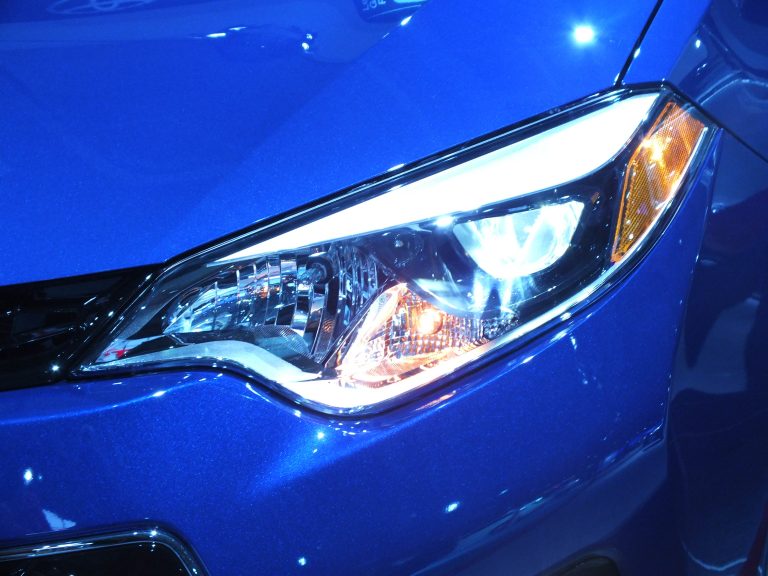

Scroll through any Jeep forum’s headlight thread and one feature keeps coming up ahead of beam pattern or brightness: the ring. A halo ring is a circular light source built into the headlight housing around the main beam, usually run as a daytime running light or accent light, and on a growing number of aftermarket products it’s also color-changeable, controllable from a phone app or wireless remote. It’s the feature that turns a headlight upgrade into a styling statement, and also the one that generates the most confused installs and “is this even legal” questions.
This guide is deliberately narrow. We’re not re-litigating round 7-inch housing selection, the JK-versus-JL fitment split, or FMVSS 108 sealed-beam compliance for the main beam — our Jeep Wrangler LED headlights guide already covers that ground in full, including JW Speaker’s 8700 Evolution J2 Series and the round sealed-beam-format product category. What follows is specific to the ring itself: which current Jeep-fit products build one in, how the ring circuit works separately from the main beam, what RGB and color-changing control looks like in practice, and the wiring and compliance details that only apply once you’re dealing with a second lighting circuit layered on top of a standard headlight.
Key Takeaways
- A halo ring is a separate LED circuit from the main high/low beam, which is why most halo-equipped headlights ship with an extra wire beyond a simple plug-and-play harness.
- Current Jeep-fit halo products range from ORACLE’s multi-zone Oculus ColorSHIFT system to budget app-controlled kits from Xprite, Auxbeam, and similar brands — verify the exact part number for your generation before buying.
- RGB and color-shifting halo modes are widely marketed “for off-road and show use,” not street use; solid white is the halo color broadly treated as street-legal for a front-facing DRL function.
- App and Bluetooth remote control is standard on RGB halo kits, but a physical dial or button controller is often more reliable for anyone who wants the halo working every time the Jeep starts, without pairing a phone first.
- Housing selection, JK/JL fitment, and main-beam DOT compliance are separate questions covered in our Wrangler LED headlights guide; this guide is purely about the ring feature layered on top.
The Halo Headlights Worth Buying
ORACLE Lighting Oculus™ ColorSHIFT Bi-LED Headlights
ORACLE’s Oculus line is the most fully-built-out halo system sold for Jeep, built around three independently addressable RGB zones rather than a single ring: an outer halo, an inner halo, and a color-changing “demon eye” projector center, each with its own cable output so they can run together or as separate zones (per ORACLE’s product listing, retrieved August 2026). Fitment covers the 2018-2025 JL Wrangler and 2020-2025 JT Gladiator, with a separate 7-inch version for the JK. Control runs through ORACLE’s BC1 or BC2 controller hardware paired with a smartphone app, and the standard BC2 kit handles all three zones from one controller. ORACLE’s own listing is explicit that the ColorSHIFT features are intended for off-road and show use, not street-legal RGB operation.
Best for: JL/JT owners who want the most granular halo control and are comfortable running the app-and-controller setup that comes with it.
Xprite Exhibit Series 7″ RGB Chasing Halo Headlights
Xprite’s Exhibit Series builds a “chasing” halo effect into a 7-inch round housing sized for the JK, with the halo marketed as DOT-approved for its DRL use and Bluetooth app control for the RGB color and pattern functions (per Xprite’s product listing, retrieved August 2026). “Chasing” means color moves around the ring rather than the whole ring changing at once, a step beyond the static or fading modes on simpler kits. Xprite’s own installation documentation notes the halo needs its own accessory-power connection separate from the plug-and-play main-beam harness.
Best for: JK owners who want an animated halo effect rather than a static color, and don’t mind running one extra wire to get it.
Auxbeam RGB Flowing Halo Headlights (App Control)
Auxbeam sells 7-inch RGB halo headlights for JK/TJ/LJ platforms and a corresponding 9-inch version for the JL, both built around a “flowing” RGB halo ring with app control over color, brightness, and lighting mode, including music-sync and preset scene modes (per Auxbeam’s product listings, retrieved August 2026). It’s a lower-priced entry point into RGB halo functionality than ORACLE’s multi-zone system, with one ring zone instead of separated outer/inner/center zones, and it’s a commonly cited budget option in current Jeep forum threads on RGB halos.
Best for: shoppers who want RGB halo functionality without ORACLE’s multi-zone price tag.
LoyoLight 7″ RGB Halo Headlights, DOT E-Mark Certificated
LoyoLight’s 7-inch RGB halo headlight is built for the JK and marketed with a DOT and E-Mark certification claim called out on the listing, plus an integrated turn-signal function (per LoyoLight’s product listing, retrieved August 2026). A DOT/E-Mark claim on a product like this typically covers the main-beam photometric performance and the amber turn-signal function, not the RGB halo color modes — a distinction we cover in the compliance section below rather than taking any listing’s certification claim at face value for every function.
Best for: JK owners who want a documented compliance claim on the main lighting functions alongside a lower-cost RGB halo ring.
How a Halo Ring Actually Works
A halo ring in a modern LED headlight is a physically distinct circuit from the main beam. The main beam — the high and low beam elements that provide forward road illumination — sits behind or beside a separate ring-shaped LED board (or, on some designs, a light pipe fed by LEDs at one point on the ring) that’s wired independently. That separation is why halo functionality is almost always the thing that needs an extra wire: the main beam pulls power from the same low-beam/high-beam wiring the factory harness already provides, but the ring has no factory-equivalent circuit to tap into, so it needs its own connection to a switched power source.
On simpler halo-equipped headlights, that ring circuit runs one fixed color, almost always white, functioning purely as a DRL or accent light. On RGB-capable products, the ring (or, on multi-zone designs like ORACLE’s Oculus, multiple rings plus a center projector element) is built from addressable RGB or RGBW LEDs instead of fixed-color LEDs, which is what makes color and pattern control possible. The main beam’s brightness, beam pattern, and DOT compliance claims are unaffected by any of this — whether the ring is on, off, white, or cycling colors has no bearing on the low-beam cutoff or high-beam output covered in our Wrangler LED headlights guide. The two systems share a housing but not a circuit.
RGB and Color-Changing Options: How They’re Actually Controlled
Three control methods show up repeatedly across current Jeep-fit halo products. The most common on RGB kits is a Bluetooth app paired with a small in-line controller box wired between the halo’s power feed and the vehicle’s accessory circuit; the app handles color selection, brightness, and preset light shows, and several current listings (Auxbeam and Xprite among them) also advertise music-sync modes. The second is a physical wireless remote, a key-fob-style transmitter that ships with many budget RGB kits as a primary control or a backup to the app. The third, used on ORACLE’s higher-end Oculus system, is a dedicated hardware controller (BC1 or BC2) that manages multiple independent RGB zones at once and syncs with ORACLE’s own app, aimed at buyers running separate outer-ring, inner-ring, and projector-center colors rather than one uniform ring color.
The practical trade-off is reliability versus flexibility. An app-and-Bluetooth setup gives the most color and pattern options but depends on a phone being in range and paired correctly, which is the most common complaint in Jeep forum threads about RGB halo kits — app disconnects, needing repairing after a battery disconnect, or mixing up which app controls which accessory. A physical remote or dashboard switch works instantly without a phone, at the cost of fewer preset options. If the halo’s job is primarily DRL duty with occasional color changes for shows, a simple white-default kit with app control as a secondary option is the lower-hassle choice.
DRL and Street-Legal Considerations Specific to the Halo Function
This is the point where halo-specific compliance diverges from the main-beam FMVSS 108 compliance our Wrangler LED headlights guide already covers. A complete round 7-inch LED headlight assembly can be a fully DOT/FMVSS 108-compliant main beam and still carry a halo ring whose RGB color modes aren’t intended for on-road use at all. ORACLE’s own Oculus ColorSHIFT documentation states the ColorSHIFT features are intended for off-road and show use, a disclaimer that’s common across RGB halo products generally, not an ORACLE-specific caveat (per ORACLE’s product listing, retrieved August 2026). The reason is straightforward: most U.S. states restrict which colors can be shown from the front of a vehicle, white is broadly accepted for a front-facing DRL function, and red, blue, and animated or flashing RGB modes carry restrictions that vary by state and are frequently the specific modes called out in “off-road/show use only” disclaimers.
A DOT or E-Mark certification claim on a halo-equipped listing, like the one LoyoLight advertises, should be read as applying to the functions the standard actually governs — typically main-beam photometric output and an integrated amber turn-signal function — not automatically to every RGB color mode the ring can display. If daily on-road use with a working, compliant DRL is the goal, running the halo in fixed white lines up with how these products are marketed and how most state front-lighting-color rules are written; treating RGB color-cycling as an on-road feature is where buyers run into the same “advertised compliant but not in every mode” gap common to aftermarket lighting generally. None of this changes the main beam’s own FMVSS 108 status, which depends on the housing and bulb assembly covered in our Wrangler guide, not on whether it happens to have a halo ring.
Wiring and Installation Notes: Plug-and-Play vs. the Halo Wire
Every halo-equipped headlight in this guide plugs into the factory harness for the main beam the same way a non-halo LED headlight would — that part is genuinely plug-and-play on JK and JL applications alike. The halo ring is where installs go sideways for first-timers, because it needs a separate 12-volt connection the factory harness doesn’t provide. The typical pattern, consistent across the Xprite, Auxbeam, and similar kits above, runs the halo’s positive lead to a switched accessory (ACC) source rather than constant battery power, using a fuse tap into the Jeep’s fuse box, and grounds the negative lead to a chassis ground point. Wiring to ACC instead of constant power is what determines whether the ring turns off with the ignition or stays lit with the engine off and drains the battery — the single most common wiring mistake reported in Jeep-forum halo installs.
Multi-zone kits like ORACLE’s Oculus add a second layer: since the outer halo, inner halo, and projector-center are independently addressable, the controller module needs a mounting location (typically behind the grille) and its own zone connections back to each ring, on top of the ACC and ground wiring every RGB kit needs. Budget single-zone kits skip that step. Running the power lead through a proper fuse tap, rather than splicing into an existing circuit, is the detail installers most often flag as worth the extra effort.
| Product | Platform fit | Halo zones | Control method | Compliance note |
|---|---|---|---|---|
| ORACLE Oculus ColorSHIFT | JL/JT (7″ JK version also available) | Outer halo, inner halo, projector center (3 zones) | BC1/BC2 controller + app | RGB modes marketed for off-road/show use |
| Xprite Exhibit Series | JK (7″) | Single ring, chasing effect | Bluetooth app | DRL function marketed DOT-approved |
| Auxbeam RGB Flowing Halo | JK/TJ/LJ (7″), JL (9″) | Single ring | App (music-sync, scene modes) | Verify certification claim per listing |
| LoyoLight RGB Halo | JK (7″) | Single ring + turn signal | App/remote | DOT/E-Mark claim on main beam & signal |
Frequently Asked Questions
What’s the difference between a halo ring and a regular DRL?
Functionally they can do the same job — a halo ring is a ring-shaped light source, and running it as a fixed white circuit is a common way manufacturers implement a DRL. The difference is form factor and flexibility: a halo is a circle around the main beam rather than a separate strip, and on RGB-capable products it can also switch to colors and patterns beyond plain white.
Do I need any special wiring for a halo headlight, or is it plug-and-play?
The main beam is plug-and-play into the factory harness on JK and JL applications. The halo ring almost always needs its own dedicated wire run to a switched accessory power source, separate from the main-beam connector, because the factory harness has no circuit built for it.
Are RGB color-changing halo headlights legal to drive with on public roads?
Running the halo in white for DRL duty aligns with how these products are marketed and with most state rules on front-facing light color. RGB color-cycling, flashing, and multi-color modes are widely disclaimed by manufacturers, including ORACLE, as intended for off-road or show use rather than everyday street driving.
Does a DOT or E-Mark certification on a halo headlight cover the RGB modes too?
Generally no. A DOT/E-Mark claim typically covers main-beam photometric performance and any integrated turn-signal function, not the full range of RGB halo color modes a product can display. Check what the certification claim actually applies to before assuming every function is covered.
Can I add a halo ring to a headlight I already bought, like the JW Speaker 8700 series?
Not as a simple retrofit. Halo functionality has to be built into the housing as a separate LED ring circuit during manufacturing; you can’t wire an aftermarket ring into a sealed assembly that wasn’t designed for one. Buy a housing that includes it from the start.
Why does my halo flicker or stay dim compared to demo videos?
The most common cause reported in installation threads is a halo wired to an underpowered or shared circuit rather than a dedicated fuse-tapped accessory line, which starves the ring of consistent voltage, especially on multi-zone kits. Confirm the halo has its own clean ACC connection and ground before assuming the product is defective.
Do halo headlights work the same on a Gladiator as a Wrangler?
Where the JT Gladiator shares JL-generation front-end hardware, halo-equipped headlights built for the JL Wrangler frequently list JT Gladiator compatibility too, including ORACLE’s Oculus line. Our Gladiator LED headlights guide covers Gladiator-specific trim and housing details if that’s the platform you’re shopping.
The Bottom Line
The halo ring is a genuinely separate feature from everything our general Wrangler LED headlights guide covers, and it deserves its own shopping checklist. Decide first whether you want a single fixed-color ring for daily DRL use or full RGB control, since that determines whether you’re looking at a simple budget kit or a multi-zone system like ORACLE’s Oculus. Whatever you pick, plan on running a dedicated accessory-power wire to the halo circuit rather than assuming the headlight is a one-connector install, and treat RGB color-cycling as an off-road/show feature rather than a street-legal DRL configuration unless you’ve confirmed otherwise. The housing format, JK/JL fitment, and main-beam DOT compliance underneath all of this are still the questions our Jeep Wrangler LED headlights guide answers in full — this guide is just the layer on top, for the ring.