
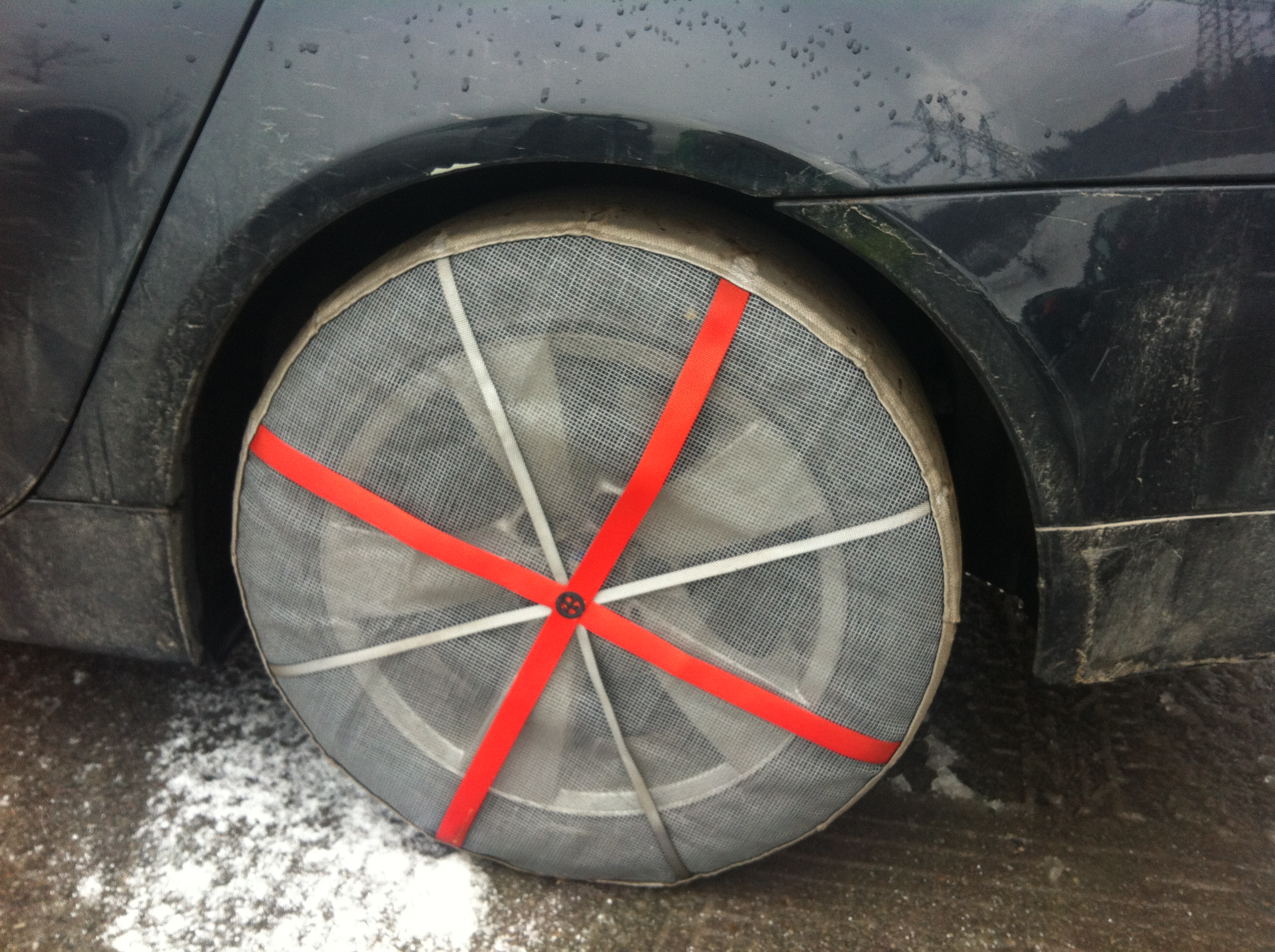
A pair of steel snow chains weighs roughly 48 pounds and can take a driver 15 to 20 minutes to wrestle onto a tire in a parking lot with cold hands and bad lighting. A textile snow sock, by contrast, weighs less than 6 pounds per pair and most drivers can pull one over a tire in under five minutes without tools. That weight and time difference is why fabric traction aids — commonly called snow socks, tire socks, or auto socks — have become one of the fastest-growing categories in winter driving gear, and why more state transportation departments now explicitly recognize them as a legal alternative to metal chains. If you drive through occasional snow rather than daily mountain passes, a snow sock may be the single most practical piece of winter equipment you can keep in the trunk.
Key Takeaways
- Textile snow socks weigh about 5-6 pounds per pair versus roughly 48 pounds for a comparable set of steel snow chains.
- Most snow socks install in under 5 minutes with no tools, compared with 15-20 minutes or more for traditional chains.
- Snow socks are legally recognized as a chain alternative in all 50 U.S. states and in most European countries with chain-control laws, though local signage should always be checked.
- Manufacturers rate snow socks for speeds up to about 30 mph (roughly 50 km/h) — significantly lower than the 25-30 mph typical for metal chains, so they are built for careful, temporary use rather than sustained highway driving.
- Sizing is vehicle- and tire-specific, so measuring exact tire dimensions before ordering matters more than guessing by vehicle model alone.
Snow Socks vs. Traditional Tire Chains
Snow socks and metal snow chains solve the same problem — getting a tire to bite into snow and ice when the tread alone can’t — but they get there in very different ways, and the differences matter when you’re deciding which one belongs in your trunk.
Weight and storage. A set of steel link chains for a passenger car typically weighs 15-25 pounds per tire, or around 40-50 pounds for a full pair, and takes up a bulky, grease-prone bag in the trunk. A pair of textile snow socks folds down to about the size of a rolled sweater and weighs under 6 pounds total, which matters if you’re trying to keep unsprung cargo weight down or simply don’t want a 40-pound chain bag rattling around.
Ease of installation. Chains require draping links over the tire, connecting hooks or tensioners, and often re-tightening after driving a short distance. Snow socks are a single fabric sleeve that stretches over the tread like a fitted cover — no hooks, no tensioning tools, and most manufacturers advertise sub-5-minute installs even for a first-time user in the dark. This is the single biggest reason casual winter drivers reach for socks instead of chains.
Legal acceptance. In the United States, most state DOTs that mandate chains during storm advisories (California, Oregon, Washington, Colorado, and others) explicitly list “alternative traction devices” — a category that includes certified snow socks — as compliant with chain-control requirements, provided the product meets the relevant SAE or state performance standard. In Europe, countries such as Switzerland, Austria, Germany, Norway, and Sweden recognize AutoSock and similarly certified textile products under EN 16662-1, the European performance standard for textile traction devices, in areas where “snow chains required” signage is posted. Always confirm local signage and product certification before relying on socks in a mandatory chain-control zone, since a handful of jurisdictions still require metal chains specifically for heavy trucks.
Speed limits. This is where chains still have an edge for sustained driving. Traditional chains are typically rated for continuous use up to 25-30 mph. Snow socks are generally rated lower — around 30 mph maximum, with manufacturers warning that speed should drop further on ice or packed snow, and that socks should be removed once you reach clear, dry pavement since running them on bare road quickly wears out the fabric. Neither is meant for extended highway use; both are recovery and short-distance traction tools.
Fabric wear and maintenance. Chains are essentially indestructible in normal use — the main failure mode is a broken link or a lost tensioner. Snow socks are a consumable textile, so their lifespan depends on how they’re used. Driving on dry pavement, gravel, or exposed asphalt for more than a few hundred feet will visibly abrade the fibers, while use strictly on snow and ice can let a good pair last several winters. Most manufacturers recommend rinsing socks with fresh water after use to remove road salt, air-drying them fully before folding, and inspecting the elastic retention band each fall for stretch or fraying before the first storm of the season.
The Best Snow Socks for Tires Worth Buying
The snow sock market is smaller than the tire chain market, but a handful of manufacturers dominate it with certified, widely available products. Below are the models worth considering, organized by vehicle class and approximate 2026 street pricing per pair.
AutoSock AL Series (Original, for Sedans and Compact Cars)
AutoSock invented the modern textile snow sock category in Norway in the late 1990s, and the AL series is still the reference product most competitors are measured against. It uses a densely woven synthetic fiber with an elastic band that keeps tension on the tire as it rotates, and AutoSock publishes exact tire-size fitment charts rather than relying on vehicle make and model.
Best for: Sedan, hatchback, and compact car drivers who want the most widely certified, easiest-to-source snow sock in the U.S. market.
Approximate price: $79-99 per pair.
AutoSock AA Series (for SUVs and Crossovers)
The AA series is AutoSock’s mid-size fitment line, built for the larger tire diameters common on crossovers and mid-size SUVs. Construction is the same high-tenacity woven fabric as the AL series, just cut and reinforced for a bigger tire footprint and the added weight those vehicles carry.
Best for: Crossover and mid-size SUV owners who need a larger fitment than the standard sedan-sized sock.
Approximate price: $99-129 per pair.
AutoSock HD Series (for Light Trucks and Vans)
The HD line adds a heavier-denier fabric and reinforced stitching to handle the higher loads and larger tire sizes of pickups, work vans, and full-size SUVs. It’s the version most often stocked by fleet and delivery operators who need a fast, tool-free traction option for drivers who aren’t chain experts.
Best for: Pickup trucks, cargo vans, and full-size SUVs, including light commercial fleets.
Approximate price: $139-169 per pair.
ISSE Super Textile Snow Socks (Passenger Car)
ISSE is an Italian manufacturer that has certified its textile socks to the EN 16662-1 European standard and sells widely in North America through auto parts retailers and online marketplaces. The fabric has a slightly heavier weave than AutoSock’s, which some reviewers report gives marginally better grip on packed snow at the cost of a bit more bulk when stored.
Best for: Drivers who want a European-certified alternative to AutoSock with strong availability through U.S. auto parts chains.
Approximate price: $99-139 per pair.
ISSE Super Textile Snow Socks (SUV/4×4)
The larger-fitment version of ISSE’s passenger sock, sized for SUV and light 4×4 tire diameters. It carries the same EN 16662-1 certification and construction as the passenger-car version, just scaled up.
Best for: SUV and 4×4 owners who prefer ISSE’s heavier weave over AutoSock’s lighter fabric.
Approximate price: $129-169 per pair.
Michelin Easy Grip Evolution
Michelin licenses and rebrands textile snow socks under its own name, and the Easy Grip Evolution is the current passenger-car version sold through Michelin’s retail and online channels. The tire-maker’s involvement mostly adds brand trust and a fitment chart cross-referenced against Michelin’s own tire catalog, which simplifies sizing for owners running Michelin tires.
Best for: Drivers who want a big-brand name and a fitment process tied directly to Michelin tire sizes.
Approximate price: $89-119 per pair.
Michelin Easy Grip SUV
The SUV-sized counterpart to the Evolution, cut for larger wheel and tire combinations. Installation and material are consistent with the passenger version, just scaled for bigger fitments.
Best for: SUV owners who want the Michelin fitment chart and brand backing in a larger size.
Approximate price: $109-149 per pair.
Install Time and Speed Rating at a Glance
The two charts below summarize the practical differences drivers care about most: how long installation takes, and how fast each traction device is rated to be driven.
Snow sock installation times cluster tightly around the manufacturer’s advertised 3-5 minute window because the process is simple: stretch the fabric over the tread, tuck the retaining strap, and roll the car forward a few feet to seat it. Chain installation times vary far more depending on chain style (ladder vs. diamond pattern) and driver experience, which is why the average sits well above the fastest possible chain installs.
Snow Sock Comparison Table
| Product | Vehicle Class | Weight per Pair | Approx. Price |
|---|---|---|---|
| AutoSock AL Series | Sedan / Compact | ~5 lbs | $79-99 |
| AutoSock AA Series | SUV / Crossover | ~6 lbs | $99-129 |
| AutoSock HD Series | Light Truck / Van | ~7.5 lbs | $139-169 |
| ISSE Super Textile (Passenger) | Sedan / Compact | ~5.5 lbs | $99-139 |
| ISSE Super Textile (SUV/4×4) | SUV / 4×4 | ~6.5 lbs | $129-169 |
| Michelin Easy Grip Evolution | Sedan / Compact | ~5 lbs | $89-119 |
| Michelin Easy Grip SUV | SUV / Crossover | ~6 lbs | $109-149 |
Frequently Asked Questions
Are snow socks as effective as tire chains?
On packed snow and light ice, certified snow socks perform comparably to entry-level chains, since both work by breaking through the snow layer to reach a grippier surface underneath. On deep, unplowed snow or sustained mountain grades, metal chains generally provide more aggressive bite and hold up longer. For occasional storms and short trips to clear pavement, socks are usually sufficient; for regular mountain or backcountry winter driving, chains remain the more robust choice.
Can I leave snow socks on for a long drive?
No. Snow socks are designed for temporary use — getting up a snowy driveway, through a storm advisory zone, or over a mountain pass — not for extended highway driving. Manufacturers recommend removing them once you reach consistently clear, dry pavement, since the fabric wears quickly on bare roads and isn’t rated for sustained high-speed use.
Do snow socks fit all tire sizes?
No single sock fits every tire. Manufacturers publish size charts keyed to exact tire dimensions (for example, a 205/55R16), not vehicle make and model, so you need to measure or look up your specific tire size before ordering. Buying based on “fits most sedans” marketing without checking the size chart is the most common fitment mistake.
Are snow socks legal everywhere chains are required?
In most U.S. states and many European countries, certified textile traction devices satisfy chain-control requirements for passenger vehicles, but this isn’t universal. Some jurisdictions restrict alternative traction devices to certain vehicle classes or require metal chains specifically for commercial trucks. Always check the posted signage or your state DOT’s traction-device policy for the specific chain-control zone you’re driving through.
How many times can I reuse a pair of snow socks?
Quality snow socks are reusable for multiple winter seasons if they’re removed before extended dry-pavement driving and stored clean and dry between uses. Most manufacturers don’t publish a hard use-count limit, but heavy or frequent use on abrasive surfaces will wear the fabric faster and shorten the usable life compared with occasional storm-only use.
The Bottom Line
Snow socks won’t replace dedicated winter tires for drivers who face snow and ice every day, and they won’t out-grip a heavy-duty chain on a steep, unplowed mountain road. But for the much larger group of drivers who occasionally get caught in a storm, need to clear a mandatory chain-control checkpoint, or just want a lightweight backup that doesn’t require wrestling with cold metal links in a parking lot, a certified textile snow sock is genuinely one of the best pieces of winter gear you can buy.
The right way to shop this category is to start with your exact tire size — printed on the tire sidewall — rather than your vehicle’s trim level, since two versions of the same model can ride on different wheel and tire combinations. From there, match your vehicle class to one of the product tiers above: sedans and compact cars fit comfortably into the entry-level AL, Michelin Evolution, or ISSE passenger lines, while SUVs, crossovers, and light trucks need the reinforced fabric and larger cut of the AA, HD, or SUV-rated versions. Keep the pair in a dedicated bag in the trunk, rinse and dry them after every use on salted roads, and check the elastic band each fall before the first storm arrives. Do that, and a $100 pair of snow socks can realistically save you from being stranded at a chain-control checkpoint, a steep driveway, or an unexpected early-season storm for several winters running. Buy before you need them — not while you’re pulled over on the shoulder in the first flurries of the season, watching other drivers who planned ahead simply strap in and drive on.