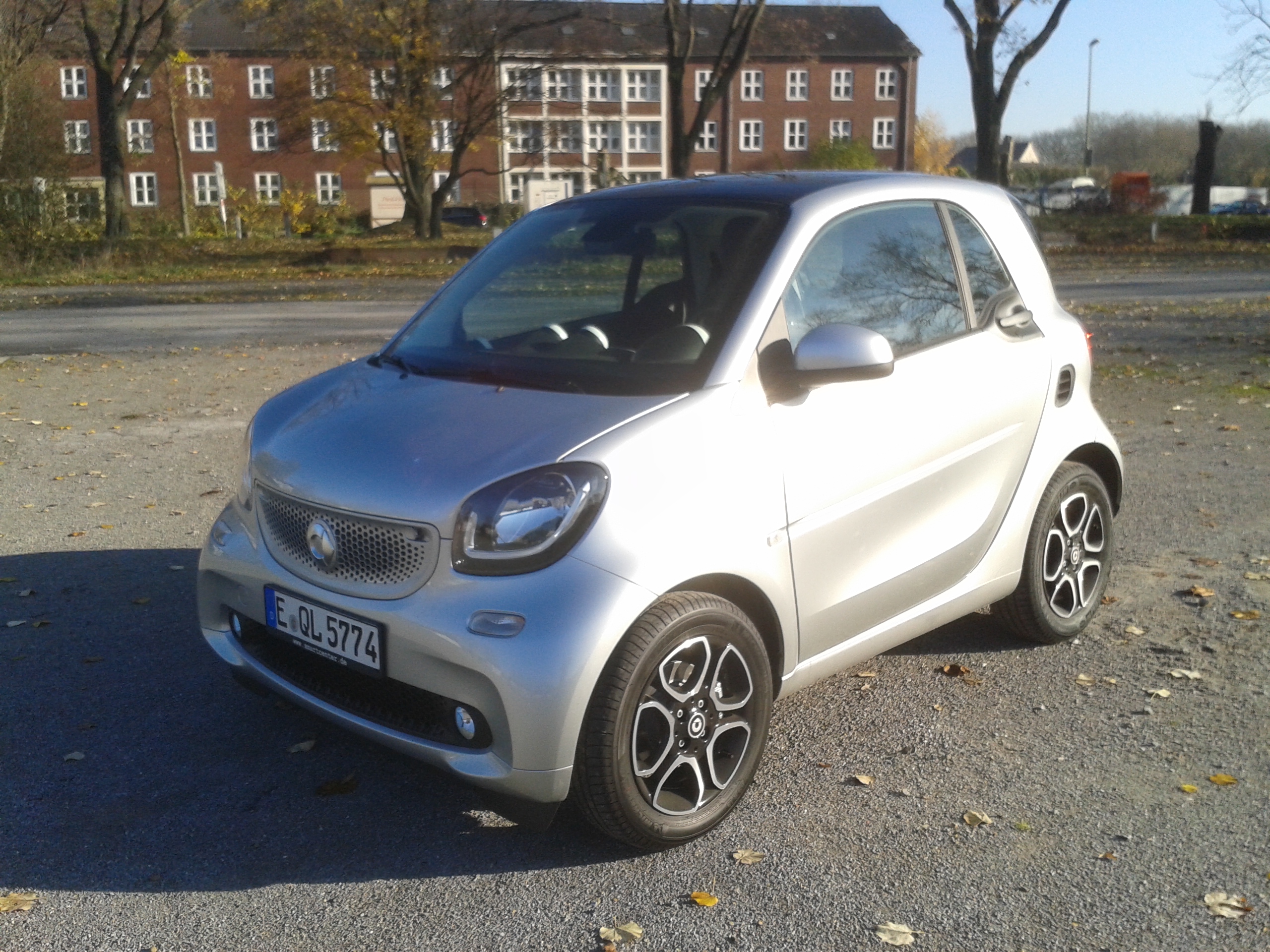
A Smart Fortwo weighs roughly 1,880-1,975 pounds (853-896 kg) curb weight, making it one of the lightest cars ever sold in the U.S. market — about a third the weight of the average new vehicle. The four-door Smart Forfour weighs more, at 2,200-2,300 pounds for gas versions and up to 2,535 pounds for the electric EQ Forfour. This guide breaks down exact weights by model and trim, explains why Smart cars are so light, and covers what that low weight actually means for safety, towing, and fuel economy.
Key Takeaways
- The two-seat Smart Fortwo weighs 1,880-1,975 lbs curb weight, depending on trim and powertrain.
- The four-seat Smart Forfour weighs more — 2,200-2,300 lbs for gas models, up to roughly 2,535 lbs for the electric EQ Forfour.
- The average new passenger vehicle in the U.S. weighs about 4,371 lbs — meaning a Smart Fortwo weighs roughly a third as much (ConsumerAffairs, retrieved 2026-08-17).
- Smart discontinued sales in the U.S. and Canada after the 2019 model year, so all Smart cars on American roads today are used.
- Light weight helps fuel economy and maneuverability but is a real disadvantage in a crash against a much heavier vehicle — physics doesn’t care about safety ratings.
How Much Does Each Smart Car Model Weigh?
Weight varies by body style, generation, and whether the car runs on gas or electric power. Here’s the breakdown across the Smart lineup sold in North America and Europe:
- Smart Fortwo (gas, most trims): 1,880-1,975 lbs (853-896 kg) curb weight.
- Smart Fortwo EQ (electric, 2024 model): approximately 1,975 lbs (896 kg), with exact figures shifting slightly by trim and battery state (Alibaba Car Interior guide, retrieved 2026-08-17).
- Smart Forfour (gas): 2,200-2,300 lbs (998-1,043 kg).
- Smart EQ Forfour (electric): approximately 2,535 lbs, the heaviest model in the lineup due to its larger battery pack and longer body.
The pattern is consistent across the lineup: more doors, more seats, and a bigger battery all add weight, the same tradeoff that applies to nearly every car on the market — it’s just compressed into a much smaller starting point with Smart’s microcar design.
Why Are Smart Cars So Much Lighter Than Other Vehicles?
Smart cars were engineered from the ground up around minimal size and weight, not adapted from a larger platform. The Fortwo’s compact “tridion safety cell” body structure, tiny footprint (barely 8.8 feet long), and two-seat-only layout eliminate most of the mass that a standard four- or five-seat car has to carry — rear seats, a longer frame, a bigger fuel tank, and in gas trims, a larger engine.
That design philosophy is also why the Forfour, which adds two doors, two more seats, and a longer wheelbase to fit them, weighs 300-400 lbs more than the Fortwo despite sharing much of the same mechanical DNA. Every added seat and inch of body length costs weight, and Smart’s whole lineup sits near the bottom of that curve compared to mainstream compact cars.
Are Smart Cars Still Sold in the U.S.?
No. Daimler discontinued Smart car sales in the U.S. and Canada after the 2019 model year, ending the brand’s run in North America. The decision followed years of declining sales as American buyers increasingly favored SUVs and trucks over microcars — U.S. Smart sales had already dropped 58% in 2018 alone, to just 1,276 units, before the brand’s exit was formally announced (The Drive, retrieved 2026-08-17).
Every Smart car on U.S. roads today is a used vehicle from the 2019 model year or earlier, which matters for weight comparisons: you won’t find a currently-in-production Smart to check against a new car’s window sticker, so older curb weight specs from Smart’s official U.S. spec sheets remain the most reliable reference.

What Does a Smart Car’s Low Weight Actually Mean for You?
Weight isn’t just a spec-sheet number — it shapes how the car drives, how efficient it is, and how it fares in a crash.
Fuel and energy efficiency: Less mass to move means better fuel economy in gas trims and better range per kWh in the electric EQ versions, which is a big part of why the Fortwo was marketed as an efficient city car rather than a highway cruiser.
Maneuverability and parking: The Fortwo’s low weight paired with its tiny footprint makes it exceptionally easy to park and maneuver in tight city spaces — arguably the car’s single biggest selling point over a conventional compact.
Crash safety: This is the tradeoff that matters most. In a collision with a much heavier vehicle — a full-size SUV or pickup, both of which regularly weigh 5,000+ lbs — the laws of physics favor the heavier vehicle regardless of either car’s individual safety rating. Smart’s tridion safety cell was specifically engineered to compensate for the car’s low mass, but no structural design fully offsets a multi-thousand-pound weight gap in a two-vehicle collision.
Towing and hauling limits: A car this light has essentially no meaningful towing capacity and a modest payload limit, since a huge share of its own curb weight would be exceeded by even a small loaded trailer. If you’re regularly moving cargo or gear, this isn’t the vehicle class to expect flexibility from — for reference, our roundup of fast cars under $100K covers how even quick, lightweight EVs manage the same efficiency-vs-capability tradeoff at a very different price point.
Why Curb Weight Matters When Working on Any Light Car
A car’s low weight changes some practical maintenance decisions too. Jacking up a Smart Fortwo takes far less capacity than a full-size sedan or truck, so a compact electric car jack kit rated for lighter vehicles is more than sufficient — there’s no need for shop-grade capacity on a car this light. Suspension components are tuned around that lower mass too; if you’re chasing a ride quality issue, our guide to car shock absorbers explains how shock valving is matched to a vehicle’s weight, and a lightweight microcar like the Fortwo needs noticeably softer tuning than a heavier sedan to ride comparably.
Frequently Asked Questions
How much does a Smart car weigh in kilograms?
The Smart Fortwo weighs approximately 853-896 kg, and the Smart Forfour weighs approximately 998-1,043 kg for gas versions, or up to roughly 1,150 kg for the electric EQ Forfour.
Is a Smart car lighter than a Mini Cooper?
Yes, significantly. A Mini Cooper hardtop typically weighs around 2,600-2,700 lbs, roughly 700-800 lbs more than a Smart Fortwo, even though both are marketed as small city cars.
Why do Smart cars weigh so little compared to other cars their size?
Smart cars aren’t just short — they’re purpose-built as minimal two- or four-seat microcars with no wasted structure, a small fuel tank or battery, and a compact tridion safety cell frame designed specifically to minimize mass while still meeting crash structure requirements.
Does the electric Smart EQ weigh more than the gas version?
Yes. The battery pack adds meaningful weight — the Smart Fortwo EQ runs close to the top of the gas Fortwo’s weight range, and the electric EQ Forfour is the heaviest model in the entire lineup because it combines the larger four-door body with the added battery mass.
The Bottom Line
A Smart Fortwo weighs roughly 1,880-1,975 lbs and a Smart Forfour weighs 2,200-2,535 lbs depending on powertrain — both dramatically lighter than the 4,371-lb average new vehicle on U.S. roads today. That low weight is the whole point of the design: better efficiency, easier parking, and a genuinely tiny footprint, traded against real limits on towing capacity and a physics-driven disadvantage in a crash against heavier vehicles. Since Smart stopped U.S. sales after 2019, every one you’ll find today is a used model, so checking the specific model year’s spec sheet is worth doing before assuming a number from a different trim or generation applies to the car in front of you.