A leather steering wheel fails in a predictable order. First it goes glossy and slightly tacky at ten and two. Then the sheen dulls to grey. Then the colour wears through to a pale, hard surface that feels like plastic — because by that point, functionally, it is.
Most owners respond by buying leather conditioner. On a modern factory wheel that is close to the least useful product on the shelf. Not because conditioner is bad, but because it is engineered to solve a problem your steering wheel does not have.
Key Takeaways
- Nearly every factory “leather” wheel is finished (pigmented) leather — hide sealed under a colour layer and a clear polyurethane topcoat. You are cleaning and protecting a coating, not a hide.
- Thirty-second test: a water drop on the underside of the rim. If it beads and sits there, the wheel is coated and conditioner cannot penetrate it.
- Ford’s materials engineers traced premature interior wear to ethanol in hand sanitiser, titanium oxide in high-SPF sunscreen, and DEET in insect repellent. The damage arrives on your hands, not from the road.
- Buy pH-balanced, silicone-free, alcohol-free, and matte. A dressing that adds gloss to a steering wheel rim adds slip, and grip on the rim is a safety input, not a cosmetic one.
What You Are Actually Cleaning
On virtually every car built in the last three decades, the steering wheel rim is finished leather — also called pigmented leather. Chrome-tanned hide carries a pigment layer, and over that sits a flexible clear polyurethane topcoat. Colourlock, a German leather-repair chemistry specialist, describes the defining property plainly: pigmented smooth leather is the most commonly used leather for cars and furniture, and if you rub water on it, it will not penetrate the surface (Colourlock / leathercare.com, retrieved 2026-07-29).
That single sentence decides which products can possibly work.
Run the test before you buy anything. Put one drop of water on the underside of the rim, where wear is lowest. If it beads up and sits there, you have a coated wheel — which is almost certainly what you have. If it darkens the surface and soaks in within a few seconds, you have unfinished or aniline leather, which is rare on steering wheels and does want a genuine conditioner.
Here is the consequence that the category ignores. Conditioners are sold on the premise of feeding oils back into leather. On a topcoated wheel, most of that product never gets past the polyurethane. It sits on the surface of the one component in the car you grip with both hands, and then it either evaporates, transfers to your palms, or stays put and makes the rim slick.
What actually fails on a steering wheel is the coating stack, top down: the clear topcoat abrades first, then the pigment layer wears through, and only then does bare hide get exposed and start to dry and crack. Colourlock is blunt about the driver of that sequence — body sweat “is aggressive against leather and causes the colour/paint layer to soften and eventually rub off or cracks start appearing.”
The Damage Comes Off Your Hands, Not the Road
Ford runs a materials programme specifically to work out what consumer products do to cabin surfaces, and the answers are not intuitive. Testing at the Dunton Technical Centre in the UK subjects samples to temperatures up to 74°C — roughly what a car parked at the beach reaches inside — and to ultraviolet exposure of up to 1,152 hours, about 48 days of continuous bombardment (Ford of Europe media release, June 2019; test detail via Automotive Testing Technology International, retrieved 2026-07-29).
Three chemicals came out of that work by name. Ethanol, the active base in most hand sanitisers — one product Ford tested was 80 percent ethanol. Titanium oxide, present in greater quantity in higher-SPF sun lotions, which can react with plastics and with the natural oils in leather. And diethyltoluamide, the DEET in insect repellent.
Ford materials engineer Richard Kyle described how the pattern surfaced: “Sometimes what we do requires a bit of detective work. There were instances of particularly high wear in Turkey and we managed to trace it back to ethanol as a potential contributing factor.”
Read that against your own routine. Sunscreen in summer. Sanitiser in the door pocket. Hand cream. Then both hands on the rim for an hour a day, at body temperature, in a cabin that bakes. The steering wheel is the only interior surface that receives all of it, continuously, under pressure and friction.
The Hygiene Question, and Why Wipes Are the Wrong Answer
Steering wheels test filthy in every study that looks at them. A swab study commissioned by CarRentals.com measured 629 colony-forming units per square centimetre on the average steering wheel — about four times a public toilet seat (The Drive, 29 January 2019, retrieved 2026-07-29). Earlier work by Dr Ron Cutler at Queen Mary University of London put the gap higher still, at around nine times a public lavatory seat (Queen Mary University of London, April 2011).
Both are small commissioned swab studies rather than peer-reviewed microbiology, so treat the multipliers as indicative rather than precise. The direction is not in dispute, and it is entirely predictable: warm surface, constant skin contact, food, and almost no cleaning.
The instinctive fix — a disinfecting wipe — is the one to resist. Most are alcohol-based, and alcohol is exactly what Ford’s engineers identified as a contributor to premature surface wear. Wipe a coated wheel with alcohol weekly and you will strip the topcoat’s gloss, then soften it, then watch it bubble and peel at the contact points. A pH-balanced leather cleaner and a microfibre towel remove the same soil load without dissolving the finish.
What to Look For on the Label
Five criteria, and they eliminate most of the aisle:
- pH-balanced. Leather chemistry is mildly acidic. Alkaline all-purpose cleaners strip the finish and, over time, attack the stitching.
- No silicone. Silicone dressings are what make a rim feel slippery, and they build a film that later goes blotchy.
- No alcohol or aggressive solvent. See above.
- Matte finish, no dressing effect. If the product’s selling point is shine, it is the wrong product for a steering wheel.
- Colourless and fragrance-free where possible. Dyes can transfer onto light-coloured leather; you are also going to be breathing whatever you spray in an enclosed cabin.
The Cleaners Worth Buying
Lexol pH-Balanced Leather Cleaner — Best Routine Choice
Lexol has been the default recommendation in saddlery and automotive leather care for decades, and its formulation matches the criteria above almost line for line. The manufacturer states the formula is pH-balanced to match leather’s natural pH so both the surface and the stitching are protected, and that it contains “no silicones, alcohols, waxes, or additives” (Lexol, retrieved 2026-07-29).
That omission list is the whole argument. Nothing in it can make the rim slick, and nothing in it attacks the topcoat.
Best for: the wheel in a daily driver, cleaned every four to six weeks.
Sonax Leather Foam — Best for Perforated and Heated Wheels
Perforated leather is a genuine problem for liquid cleaners: spray a wet product on it and the liquid wicks through the holes into the foam beneath and, on heated wheels, toward the heating element. Sonax builds this one as an aerosol foam specifically so it “will not absorb into the perforations of the leather,” and states it contains no dyes, harsh chemicals or silicone, using modified beeswax for conditioning instead (Sonax USA, retrieved 2026-07-29).
Best for: perforated grips, heated wheels, and anyone nervous about liquid near electronics.
Chemical Guys Colorless & Odorless Leather Cleaner — Best Value
The utilitarian option. Chemical Guys states the formula is non-caustic and contains no petroleum products that could dry out or stain the leather, and that the colourless, odourless formula lifts embedded dirt and oils “without harsh chemicals that can alter color or texture” (Chemical Guys, retrieved 2026-07-29). No dye and no fragrance is the right specification for a surface you sit beside with the windows up. It also comes in a gallon, which matters if you are doing the seats as well.
Best for: a whole-interior session where the wheel is one item on a list.
Geist Dye & Friction Blocker — Best Protection Step
This is not a cleaner, and that is precisely the point. Once the wheel is clean, the failure mode that remains is abrasion — the mechanical wearing of the topcoat under your palms. Geist (from the Colourlock family) makes a hybrid-polymer barrier designed for exactly that: it reduces the impact of friction and abrasion, adds no gloss, leaves no residue or smell, does not change the soft touch or elasticity of the surface, and contains no PFOA or nanoparticles (Geist / leathercare.com, retrieved 2026-07-29).
“Adds no gloss” is the specification that matters on a steering wheel. Most protectants cannot claim it.
Best for: a wheel that already shows a shiny patch at ten and two, before the pigment wears through.
Colourlock Leather Steering Wheel Kit — Best for a Wheel Already Worn Through
Once the colour layer is gone and you are looking at pale, hard patches, cleaning cannot help. Colourlock sells a steering-wheel-specific restoration kit built around the correct sequence: deep clean, degrease with a surface prep to remove uneven topcoat, sand the rough areas, apply colour restorer, then apply the friction blocker the following day to make the repair durable (Colourlock, retrieved 2026-07-29).
The same guidance is honest about the limit: extremely brittle or broken leather should be re-trimmed, not re-coated.
| Product | Type | Stated formulation | Best for |
|---|---|---|---|
| Lexol pH-Balanced Cleaner | Liquid cleaner | pH-balanced; no silicones, alcohols or waxes | Routine maintenance |
| Sonax Leather Foam | Aerosol foam | No dyes or silicone; modified beeswax; safe on perforations | Perforated / heated wheels |
| Chemical Guys Colorless | Liquid cleaner | Non-caustic; no dyes, fragrance or petroleum | Whole-interior sessions |
| Geist Dye & Friction Blocker | Protection | Hybrid polymers; no added gloss; no PFOA or nanoparticles | Stopping abrasion wear |
| Colourlock Steering Wheel Kit | Restoration | Clean, prep, sand, re-colour, protect | Colour already worn through |
What Not to Use
- Disinfecting or alcohol wipes. The fastest way to destroy a topcoat. If someone in the car is ill, wipe the hard plastics and use a leather cleaner on the rim.
- All-purpose cleaner (APC). Even diluted, it is alkaline and it is designed to strip. It will take the finish along with the grime.
- Silicone dressings. The shine products belong on door cards, not on the control you steer with. Whatever gloss they add, they add slip alongside it.
- Melamine foam (“magic eraser”). It is a fine abrasive. It removes the shiny patch by removing the coating that made it shiny.
- Household oils. Olive oil and similar go rancid, attract dirt, and cannot penetrate a topcoat anyway.
- Stiff brushes. A soft interior brush only, and light pressure. The rim is already the most abraded surface in the car.
How to Clean a Leather Steering Wheel Properly
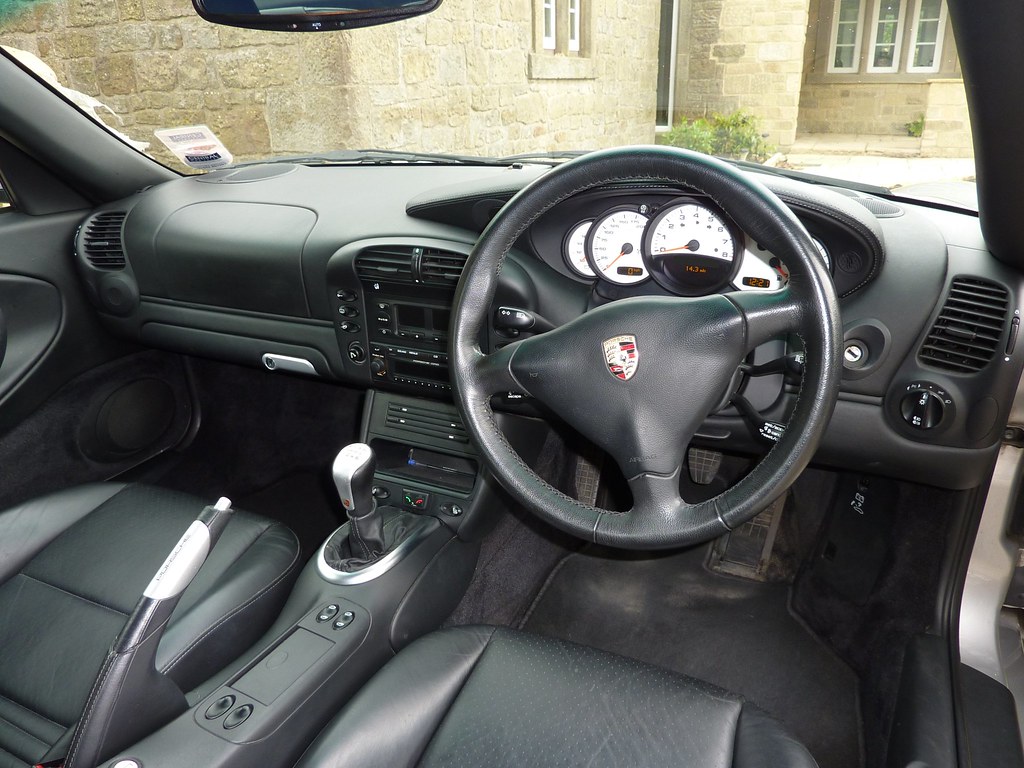
- Spray the towel, never the wheel. Overspray runs into the column shroud, the horn contacts, the airbag seam and the switchgear. Two or three sprays onto a folded microfibre is enough for the whole rim.
- Work one quarter at a time. Clean a quarter, wipe it dry, move on. Letting cleaner dwell and dry on a coated surface leaves streaks.
- Agitate lightly where it is glossy. A soft interior brush, small circles, minimal pressure. That gloss is compacted skin oil sitting in the grain, and it lifts with far less force than people expect.
- Wipe with a clean, dry towel. Not the one you cleaned with. Any residue left behind is residue you will be gripping.
- Check for transfer. Run a white towel over the rim. If it picks up colour, the pigment layer is already compromised and no cleaner will fix it — that is a restoration job.
- Protect, then leave it alone. Apply a matte, non-glossing protectant if you use one, let it flash off, and do not condition. Every four to six weeks is plenty for a daily driver.
The whole job takes ten minutes. What makes it work is doing it on a schedule, before skin oil has months to compact into the grain.
If Your Wheel Is Not Leather
Alcantara or suede. Completely different material, completely different rules. BMW directs owners to a dedicated Alcantara cleaner specifically because it maintains breathability, colour and the material’s antistatic properties, applied with a sponge and then cleaned off with warm water (BMW USA, retrieved 2026-07-29). Greasy leather conditioners are the thing most likely to mat the pile permanently — never use one.
Synthetic leather (leatherette, PU, SofTex, MB-Tex). Good news: a pH-balanced leather cleaner is fine, and the surface is more chemically robust than real hide. It still hates alcohol, and it still goes slick under silicone.
Wood or carbon inserts. Keep leather cleaner off the lacquer. A damp microfibre and a dry buff is all they want.
Heated wheels. Minimal moisture, always. Foam over liquid, and never spray directly.
Frequently Asked Questions
Can I use leather conditioner on my steering wheel?
On a factory wheel, usually not usefully. Finished leather carries a polyurethane topcoat that conditioner cannot penetrate, so it sits on the surface and can make the rim slippery. Clean it and protect it against abrasion instead. Conditioner only makes sense on an unfinished or aniline wheel, which you can identify with the water-drop test.
Are disinfectant wipes safe on a leather steering wheel?
No. Most are alcohol-based, and Ford’s materials research identified ethanol as a contributor to premature wear on interior surfaces. Repeated use strips the topcoat, after which it can bubble and peel. Use a pH-balanced leather cleaner and a microfibre towel instead.
How often should I clean a leather steering wheel?
Every four to six weeks for a daily driver. The point of the schedule is to remove skin oils and sunscreen residue before they have time to compact into the grain and attack the finish.
Why is my steering wheel shiny and sticky?
That is compacted skin oil, sweat and cosmetic residue sitting in the grain of the topcoat, not the leather itself changing. It cleans off with a pH-balanced cleaner and light agitation. If wiping transfers colour onto a white towel, the pigment layer underneath has already worn and needs re-colouring.
Does hand sanitiser really damage a steering wheel?
Yes, if it goes on wet. Ford engineers traced regional patterns of elevated interior wear back to ethanol as a contributing factor, and one sanitiser they tested was 80 percent ethanol. Let sanitiser dry fully on your hands before you take the wheel.
Will cleaning fix a worn, faded steering wheel?
No. Cleaning removes what sits on the surface. Once the colour layer has abraded through to pale patches, the fix is a re-colour with a proper prep, sand and seal sequence — or, if the leather has gone brittle and split, a re-trim.
The Bottom Line
Buy a pH-balanced, silicone-free, alcohol-free cleaner and a matte abrasion protectant. Lexol for routine work, Sonax Leather Foam if the wheel is perforated or heated, Geist Dye & Friction Blocker as the protection step, Colourlock’s kit if the colour has already gone. Skip the conditioner unless the water-drop test tells you the wheel actually needs one.
Then change the habit doing the damage: let sunscreen and sanitiser dry on your hands before you take the wheel. That costs nothing, and it outperforms every product on this page.
If you look after your interior at this level, the same logic applies to the paint — our guide to what “9H” really measures on a ceramic coating covers a similar gap between what a product claims and what it does, and our headlight clear coat guide covers the one exterior job most owners get wrong.
Brakes, Exhaust and NJ Inspection — Keyport, NJ
A spotless interior does not help you stop or pass inspection. Discount Brakes and Mufflers has served Keyport and Monmouth County for over 40 years as an NJ State Inspection Facility, and we repair rather than replace wherever the part allows — usually why our quotes come in lower.
Get a price in minutes with our instant estimate tool, see what is involved in muffler and exhaust repair, or contact our Keyport shop.
Note: this is a buyer’s guide compiled from manufacturer documentation, automaker materials research and published leather-care technical guidance. Discount Brakes and Mufflers specializes in brakes, mufflers, catalytic converters and custom exhaust; we do not perform interior restoration or leather repair.