
Nothing changes the character of an interior faster than swapping a moulded plastic rim for lacquered hardwood. It is one of the genuinely great upgrades in an older car.
It is also, in a car built after the mid-1990s, a decision to remove an airbag. That part gets skipped in most buying guides, so this one starts there and then gets to the wheels.
Key Takeaways
- Federal law prohibits a manufacturer, distributor, dealer, rental company or repair business from knowingly making a safety device inoperative — 49 U.S.C. 30122. A private owner working on their own car is not named in that list.
- That means most shops will refuse the job on an airbag-equipped car, and some states will fail it at inspection. Neither of those is negotiable by argument.
- On a pre-airbag classic, a wood wheel is a straightforward, reversible upgrade with no safety trade-off at all. That is where this product belongs.
- Fitment lives in the hub, not the wheel. Bolt-pattern diameters vary between brands, so verify the adapter against your column before ordering anything.
The Airbag Question, Answered Properly
Almost no aftermarket wood steering wheel accommodates a driver airbag. Fitting one to a car that has one means removing it, and that is where the law enters.
49 U.S.C. 30122(b) states: “A manufacturer, distributor, dealer, rental company, or motor vehicle repair business may not knowingly make inoperative any part of a device or element of design installed on or in a motor vehicle or motor vehicle equipment in compliance with an applicable motor vehicle safety standard prescribed under this chapter unless the manufacturer, distributor, dealer, rental company, or repair business reasonably believes the vehicle or equipment will not be used … when the device or element is inoperative” (49 U.S.C. 30122, retrieved 2026-07-29).
Read the list of who is bound: businesses. The federal make-inoperative provision does not name the vehicle’s owner. An individual removing an airbag from their own car is not the party the statute addresses.
Do not mistake that for permission. Three things follow regardless:
- Shops will decline the work, correctly. Asking a repair business to do this asks them to break federal law.
- State inspection and state law are separate. Several states treat a missing airbag as an inspection failure or a safety violation in their own right.
- Insurance and liability are separate again. A missing restraint in a car involved in a serious collision is a fact that gets found.
There is also a warning-light problem. Removing an airbag without a correctly valued resistor in the circuit leaves an SRS light illuminated permanently, which in many states is itself an inspection failure, and which masks any genuine fault in the rest of the restraint system.
Where a Wood Wheel Genuinely Belongs
The honest recommendation is narrower than the market suggests, and it is not a compromise — in these cars a wood wheel is simply the right part.
| Vehicle | Verdict | Why |
|---|---|---|
| Pre-airbag classic | Ideal | Nothing to remove; period-correct and reversible |
| Restoration to original spec | Ideal | Many cars left the factory with wood rims |
| Boat, tractor, off-road, show car | Fine | No FMVSS driver airbag involved |
| Modern road car with airbag | Don’t | Removing a restraint for cabin aesthetics |
| Modern car, want the look | Alternative | Have the OEM wheel rewrapped with wood inserts |
That last row is the option most people do not know exists. Specialist trimmers will rebuild your original airbag-equipped wheel with real wood inserts bonded to the existing armature. You keep the airbag, the controls and the clockspring, and you get the wood. It costs more than a bolt-on wheel and it is the only version of this upgrade that makes sense on a modern car.
What Separates a Good Wood Wheel
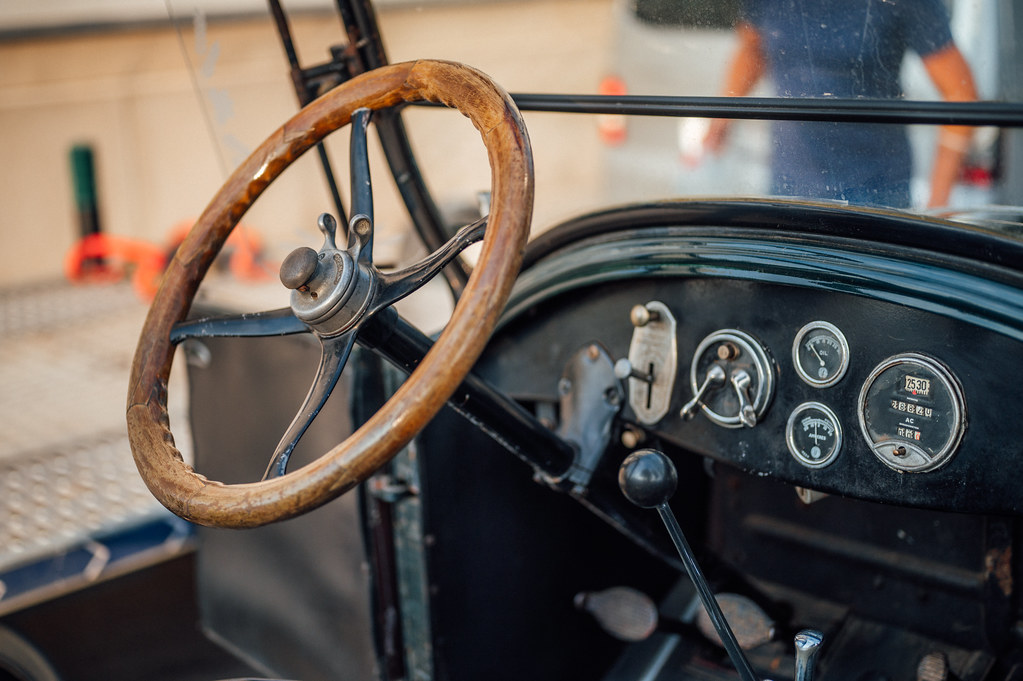
The first thing to establish is whether the wheel is wood at all. “Wood grain” describes two completely different products: laminated hardwood bonded to a steel core, and printed vinyl or hydro-dipped plastic imitating grain. The second is not a wood wheel, and it will not age like one.
Nardi Classic
The default reference in this category, and the one most often copied. Construction is strips of hardwood laminated around a steel core, sanded and sealed under lacquer, with a thin dished rim and polished spokes. Nardi offers the Classic in several diameters — 340 mm, 360 mm and 390 mm are the common ones — in walnut, beech and mahogany depending on the variant.
The thin rim section is a genuine functional difference, not just a look. A slim rim suits unassisted steering because it lets you feel the road surface through your fingers rather than gripping a padded section.
Momo Wood Range
Momo’s wood offerings sit alongside the Nardi in price and quality, with a slightly different spoke aesthetic and generally a marginally thicker rim. If your car is Italian or the interior already carries Momo parts, matching the brand is a reasonable basis for choosing.
Grant Classic Series
The budget-conscious American option, and the one most likely to bolt to a domestic classic without hunting for an adapter, because Grant supports the 3-bolt and 5-bolt patterns common on those cars. Finish quality is a step below the Italian wheels; the value proposition is fitment and price.
OEM Reproduction and Restoration
For a car being returned to original specification, a correct reproduction or a restoration of the original wheel beats any aftermarket wheel, both for feel and for value. A cracked original is usually restorable.
The Fitment Trap Is the Hub, Not the Wheel
Buying the wheel is the easy half. The wheel bolts to a hub adapter, and the hub adapter bolts to your steering column. Two independent interfaces have to match.
Six-bolt patterns are the common standard on Italian-style wheels, but the bolt-circle diameter is not identical across every brand, and listings frequently quote figures that conflict with each other. Do not order on the assumption that six bolts means interchangeable. Measure the bolt circle on the wheel you are buying, confirm it against the hub, and buy an adapter ring if they differ.
On the column side, the hub is vehicle-specific and keyed to spline count. Buy the hub for your exact make, model and year rather than something close.
Two further details people forget. Horn wiring runs through the hub and is not standardised — check the wheel and hub use a compatible contact. And self-cancelling indicators depend on a cam that the original wheel operated; many aftermarket hubs delete it, so your indicators stay on until you cancel them by hand.
Wood, Finish and Why Rims Crack
Wood moves with humidity and temperature; the steel core it is bonded to does not. Over years that mismatch produces the fine radial “finger cracks” seen on almost every vintage wheel, usually where the wood meets a spoke.
Finish is what slows this down. Factory wheels typically used lacquer, which is glossy but yellows with age, or shellac, or oil-based varnish. Restorers generally prefer modern alternatives: an oil finish such as Tung oil looks natural and is easy to touch up but offers limited moisture and UV protection, while 2K polyurethane or marine spar varnish handles sun and temperature swings far better and gives the factory-fresh gloss.
The practical implication for buyers: a car parked outdoors in strong sun will destroy an oiled rim in a few seasons. Buy a lacquered or polyurethane-finished wheel, or accept an annual refresh.
Living With One
- Keep it out of direct sun. A windscreen shade does more for a wood rim than any product you can apply to it.
- Wipe hand oils off. Sweat and sunscreen attack lacquer over time; a dry microfibre after each drive is enough.
- Never use interior dressing or silicone protectant. They leave the rim slippery, which is a genuine safety problem, and they can soften some finishes.
- Address cracks early. Restorers fill them with epoxy mixed with sanding dust from the same wheel so the colour matches. Left alone, they open up and take in moisture.
- Torque the retaining nut to spec and re-check it after a few hundred miles. A wheel that works loose is not a problem you get to notice twice.
Frequently Asked Questions
Is it illegal to fit a wood steering wheel and remove the airbag?
49 U.S.C. 30122 prohibits a manufacturer, distributor, dealer, rental company or motor vehicle repair business from knowingly making a safety device inoperative. A private owner is not named in that provision, but state inspection rules, state law, insurance and liability all apply separately — and no reputable shop will perform the work.
Can I get a wood steering wheel that keeps my airbag?
Not as a bolt-on aftermarket wheel. The route that works is having a specialist trimmer rebuild your original airbag wheel with real wood inserts on the existing armature.
What diameter should I choose?
Smaller diameters increase steering effort and reduce leverage, which is fine with power assistance and hard work without it. On an unassisted classic, staying close to the original diameter is usually the right call; 360–390 mm covers most of those cars.
Do all six-bolt wheels fit all six-bolt hubs?
No. The bolt-circle diameter varies between brands even when the bolt count matches, and published figures are inconsistent. Measure the wheel and the hub, and use an adapter ring if they differ.
How do I stop a wood rim from cracking?
Keep it out of direct sunlight, keep hand oils off it, and maintain the finish. A UV-resistant finish such as 2K polyurethane or marine spar varnish outlasts an oil finish substantially on a car that lives outdoors.
The Bottom Line
On a pre-airbag classic, a laminated hardwood wheel from Nardi, Momo or Grant is one of the best-value changes you can make to how a car feels, and the only hard part is getting the hub right. Measure the bolt circle, buy the vehicle-specific hub, and check the horn and indicator cancellation before you order.
On a modern car, the bolt-on version of this upgrade means removing a restraint. The rewrap route keeps the airbag and gets you the wood, and it is the version worth paying for.
Brakes, Exhaust and NJ Inspection — Keyport, NJ
A classic that looks right still has to stop right and pass inspection. Discount Brakes and Mufflers has served Keyport and Monmouth County for over 40 years as an NJ State Inspection Facility, bending and fabricating custom exhaust in-house, and we repair rather than replace wherever the part allows.
Get a price in minutes with our instant estimate tool, see what is involved in muffler and exhaust repair, or contact our Keyport shop.
Note: this is a buyer’s guide compiled from federal statute and manufacturer information. It is not legal advice — verify current federal and state requirements before modifying any restraint system. Discount Brakes and Mufflers specializes in brakes, mufflers, catalytic converters and custom exhaust; we do not perform interior or restraint work.