
The EPA’s own automotive refinishing case studies put conventional siphon-feed spray guns at roughly 30-40% transfer efficiency, meaning most of that paint never lands on the panel — it becomes overspray, wasted material, and extra VOC emissions. HVLP (High Volume, Low Pressure) guns, by contrast, are required by many state air-quality regulations to hit at least 65% transfer efficiency, which is why HVLP became the mandated standard for body shops in California, New York, and a growing list of other states. For a home or small-shop painter, that difference isn’t just an emissions statistic — it’s the gap between a gun that lays down smooth, even base coat and clear coat with minimal rework, and one that fights you with runs, dry spray, and a paint bill that’s 30-40% higher than it needs to be.
Key Takeaways
- HVLP guns need less air pressure at the tip (max 10 psi by regulation) but still require real CFM — most automotive HVLP guns draw 12-16 CFM at 50 psi inlet pressure, so a small pancake compressor won’t keep up.
- Tip size matters more than gun price: 1.3-1.4mm is the standard base coat/clear coat size, 1.0-1.2mm suits waterborne base coats, and 1.7-2.2mm is for primer and primer-surfacer.
- LVLP (Low Volume, Low Pressure) guns trade a bit of finish quality for the ability to run off a smaller, cheaper compressor — a reasonable compromise for occasional home use.
- Professional-grade guns (SATA, Iwata, DeVilbiss) cost 5-10x more than big-box kits but hold atomization consistency over thousands of painted panels; budget kits are fine for occasional touch-up work.
- A gun is only as good as the compressor behind it — undersized CFM causes the classic symptom of a spray gun that “spits” or fades halfway through a pass.
HVLP vs. LVLP, Tip Sizing, and CFM/Compressor Sizing
Every automotive paint gun on the market today is built around one of two air technologies, and understanding the difference will save you a wasted purchase.
HVLP (High Volume, Low Pressure) guns use a large volume of air moving at low pressure — no more than 10 psi measured at the air cap — to atomize paint. Because the air moves slower, more of the atomized paint actually reaches the panel instead of bouncing off as overspray. This is why HVLP is the legally mandated technology for automotive refinishing in most U.S. states and why every professional collision shop uses it almost exclusively. The tradeoff is that HVLP guns need a steady, high-volume air supply — typically 12-16 CFM at 50 psi inlet pressure for a full-size gravity-feed gun — which means a genuinely capable compressor, not just a big pressure gauge.
LVLP (Low Volume, Low Pressure) guns are a newer category built for painters whose compressors can’t keep up with true HVLP demand. They atomize paint using less total air volume (often 4-8 CFM) while still keeping cap pressure low. Finish quality is close to HVLP but not quite identical — LVLP guns can be slightly more prone to orange peel at fast pass speeds. For anyone running a smaller two-stage compressor or a single large tank rather than a dedicated shop compressor, LVLP is a legitimate way to paint a full panel without constantly waiting for the tank to recover.
Tip (nozzle) size is the single most important spec on any paint gun, and it needs to match the material you’re spraying, not just the gun’s price tier:
- 1.0-1.2mm — waterborne base coats, which are thinner and lower in solids than solvent-based paint.
- 1.3-1.4mm — the default size for solvent-based base coat and clear coat; if you only own one tip, this is it.
- 1.5-1.6mm — heavier clear coats and some single-stage topcoats.
- 1.7-2.2mm — primer and primer-surfacer, which are thick and need a bigger orifice to atomize without clogging.
CFM and compressor sizing is where most home painters get burned. A gun rated for 14 CFM doesn’t need 14 CFM the instant the trigger is pulled — it needs that volume sustained for the length of every pass, which is only possible with adequate tank size and compressor output, not just peak PSI. Our guide to sizing a garage air compressor breaks down tank size and duty cycle in more detail, but the short version for paint guns: look for a two-stage compressor rated at least 1-2 CFM above your gun’s stated draw at 90 psi, with a 60-80 gallon tank if you’re painting full panels rather than doing touch-up work.
The Best Automotive Paint Guns Worth Buying
These six guns span the full range from budget touch-up kits to the guns professional refinishers actually load into their booths. Prices are approximate street prices as of 2026 and vary by retailer, kit contents, and tip size ordered.
SATA jet 5000 B RP — Best for: professional collision shops and serious enthusiasts
Approximate price: $800-900 (gun only, single tip)
The SATAjet 5000 B is the gun most body shop painters point to as the benchmark. Its RP (Reduced Pressure) technology narrows the gap between HVLP compliance and the atomization quality of older high-pressure guns, giving an exceptionally fine, even fan pattern that minimizes mottling on metallic base coats. It’s available in a wide range of nozzle sizes from SATA’s RPS cup system, and the build quality — precision-machined air caps, a genuinely comfortable trigger pull — is the reason these guns routinely get rebuilt and requalified rather than replaced. It is genuinely expensive, and it’s overkill for someone painting one car every few years, but for anyone spraying regularly it pays for itself in reduced rework.
Iwata Supernova LPH400-LVX — Best for: waterborne base coats and daily shop use
Approximate price: $450-550
Iwata’s LPH400 line has been a shop staple for two decades, and the LVX variant was specifically tuned for waterborne base coat atomization, which has become the dominant technology as more states restrict solvent-borne VOCs. It runs comfortably at lower CFM than some HVLP competitors while still holding a tight, controllable pattern, and Iwata’s air caps are well regarded for producing minimal texture on metallics. It’s a gun that professional painters buy a second and third of just to keep dedicated tips loaded for base coat, clear, and primer without cross-contamination.
DeVilbiss GTi Pro Lite TE20 — Best for: painters who want SATA-level finish without the SATA price
Approximate price: $350-420
The GTi Pro Lite is DeVilbiss’s flagship refinish gun, and it consistently gets compared favorably to guns costing twice as much. The TE20 air cap technology produces a soft, controllable pattern that’s forgiving for painters still developing consistent pass speed and gun distance, and the gun itself is noticeably lighter than older DeVilbiss models, which matters over a long panel or full respray. Available in 1.2, 1.3, and 1.4mm tips, with 1.3mm being the most commonly recommended for 2K clear.
Iwata Supernova LS400 Entech — Best for: metallic and tri-coat base coats
Approximate price: $400-480
Where the LPH400 is tuned for waterborne, the LS400 is Iwata’s solvent-borne specialist, and its air cap is specifically engineered to keep metallic flake oriented evenly across the panel — a common failure point on cheaper guns, where flake ends up blotchy or streaky near panel edges. It comes with Iwata’s Entech air valve technology for a smoother, more linear trigger response, which makes feathering the fan pattern into blend panels noticeably easier.
Astro Pneumatic 4008 EuroPro Forged — Best for: the best finish-to-price ratio for a home garage
Approximate price: $100-140
This is the gun most enthusiast painters recommend to friends attempting their first full respray. It’s forged rather than cast, which gives it better long-term durability than most guns in its price bracket, and its 1.3mm and 1.4mm tip options cover base coat and clear coat without needing a second gun. It won’t match a SATA or Iwata on ultra-fine metallic control, but for a driveway or home-garage project car, the difference is marginal next to the money saved.
TCP Global 3-Gun Master Series Kit — Best for: first-time painters and occasional touch-up work
Approximate price: $70-90
TCP Global’s kit bundles two full-size HVLP guns (1.4mm and 1.8mm tips) plus a detail gun, cups, and an air regulator — essentially a complete starter setup for primer, base coat, clear coat, and small touch-ups in one box. Build quality is a clear step down from the professional guns above, and consistency between individual units varies more than with a name-brand gun, but for someone painting a bumper, fixing a scratch, or doing their first-ever full panel as a learning project, it’s a low-risk way to get started without a four-figure investment.

CFM and Price Comparison
The chart below shows approximate sustained CFM draw at 50 psi inlet pressure for each gun’s full-size tip — the number your compressor actually has to sustain through a pass, not just its peak momentary demand.
Notice that even the “budget” TCP Global kit still needs over 10 CFM sustained — well beyond what a typical 6-gallon pancake compressor can deliver for more than a few seconds. This is the single most common reason first-time painters blame the gun when the real bottleneck is the compressor.
| Gun | Base/Clear Tip Size | Sustained CFM @ 50 psi | Approx. Price |
|---|---|---|---|
| SATA jet 5000 B RP | 1.3mm | 14.8 CFM | $800-900 |
| Iwata Supernova LS400 Entech | 1.3mm | 13.8 CFM | $400-480 |
| DeVilbiss GTi Pro Lite TE20 | 1.3mm | 13.2 CFM | $350-420 |
| Iwata Supernova LPH400-LVX | 1.3mm | 12.4 CFM | $450-550 |
| Astro Pneumatic 4008 EuroPro Forged | 1.3mm/1.4mm | 11.5 CFM | $100-140 |
| TCP Global 3-Gun Master Kit | 1.4mm | 10.2 CFM | $70-90 |
On price, the spread across this list is enormous — roughly a 10x difference between the cheapest kit and the SATA flagship — but it isn’t a straight line to finish quality. A well-maintained Astro EuroPro or DeVilbiss GTi Pro Lite, in skilled hands, can produce a finish very close to a SATA on a single panel. Where the expensive guns earn their price is consistency over thousands of trigger pulls and a wider range of precision tip options for specialized coatings.
Preparing the Rest of the Job
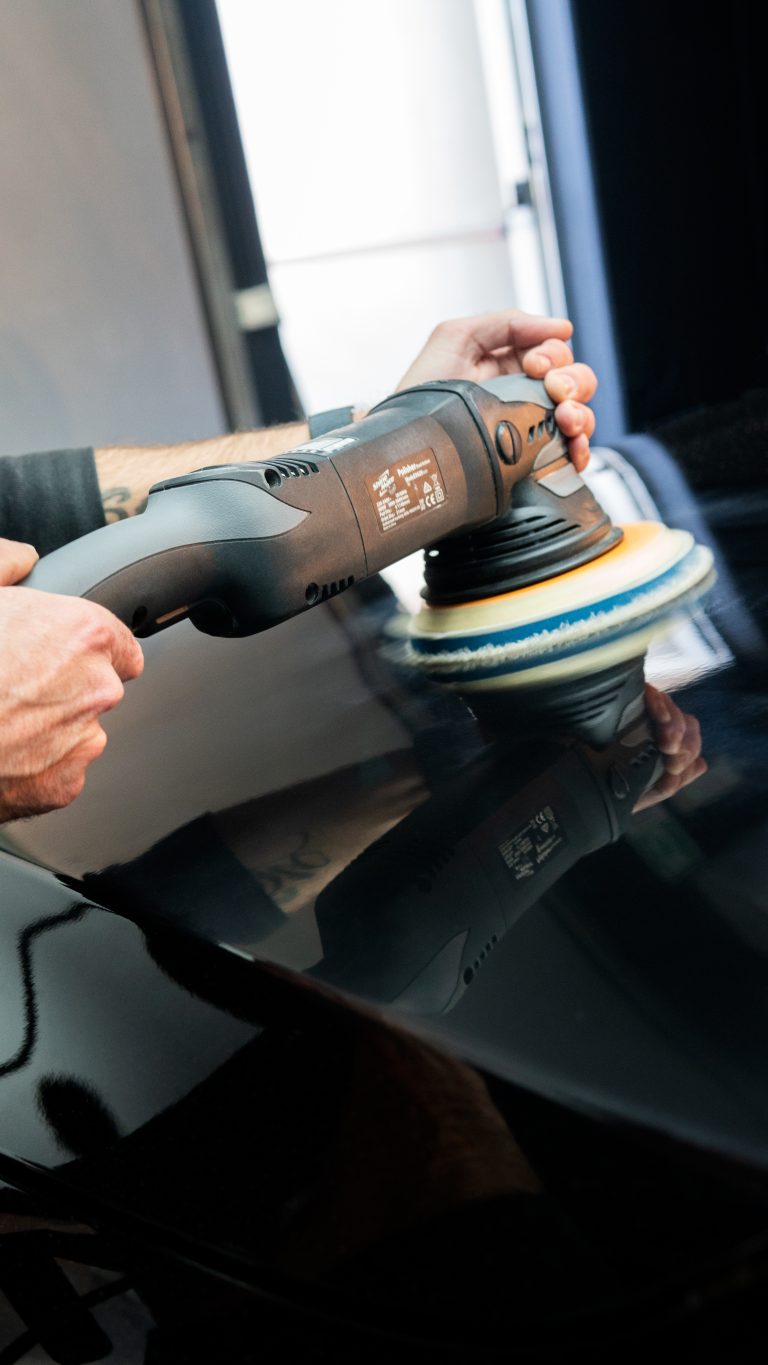
A great gun is only one piece of a clean paint job. Panels need to be sanded, masked, and dust-free before the first coat goes down, and the car needs a stable, level platform to work around — our guide to low-profile car ramps covers getting safe access underneath rockers and lower panels without a full lift. After clear coat is sprayed, cure time and dust control matter just as much as the spray technique itself; a forced-air setup like the ones in our car dryer blower comparison can help move contaminant-laden air out of a garage bay faster during flash-off between coats. And once the clear has fully cured — typically 24-72 hours depending on the product — the final step of color-sanding and machine polishing to remove any orange peel or dust nibs is where a good dual-action or rotary buffer polisher earns its keep; trying to skip straight from spray gun to showroom finish without it rarely works.

Frequently Asked Questions
What tip size should I use for automotive clear coat?
1.3mm is the standard, near-universal choice for solvent-based clear coat, and it’s the tip size most guns ship with by default. Some heavier two-part clears benefit from a 1.4mm tip, but check the manufacturer’s technical data sheet for the specific clear you’re using before assuming.
Can I use the same gun for primer and clear coat?
Not well. Primer is significantly thicker and needs a 1.7-2.2mm tip to atomize properly; running it through a 1.3mm base coat tip will clog the gun and produce a heavy, uneven texture. Most painters keep at least two guns — one dedicated to primer, one to base/clear — to avoid cross-contamination and tip-swapping mid-job.
Do I need a specific compressor for HVLP painting?
You need a compressor that can sustain 12-16 CFM at 90 psi for the length of an entire pass across a panel, not just hit that number for a second or two. A single-stage 6-gallon pancake compressor cannot do this; you need at minimum a 60-80 gallon two-stage unit for full-panel work. See our garage air compressor sizing guide for specific recommendations.
Is LVLP good enough for a full car respray?
Yes, for most home and hobbyist painters. LVLP guns sacrifice a small amount of atomization fineness compared to true HVLP, which can show up as very slightly more orange peel texture on close inspection, but that’s usually correctable with color sanding and polishing afterward. If your compressor can’t sustain true HVLP CFM demands, LVLP is a better choice than starving an HVLP gun of air.
How much does a decent starter paint gun setup cost?
A capable starter setup — one full-size HVLP or LVLP gun plus a smaller detail gun — runs $80 to $150 for a kit like the TCP Global Master Series or a single Astro Pneumatic EuroPro. That’s enough to paint a full panel or small project car; professional-grade guns from SATA, Iwata, or DeVilbiss become worthwhile once you’re painting regularly enough that finish consistency and gun longevity matter more than upfront cost.
The Bottom Line
For most home garage painters working on a project car, the Astro Pneumatic 4008 EuroPro Forged or the DeVilbiss GTi Pro Lite TE20 hit the best balance of finish quality, tip flexibility, and price — both are capable of a genuinely good base coat/clear coat job without the four-figure investment of a shop-grade gun. If you’re painting occasionally and want the lowest possible entry cost, the TCP Global 3-Gun Master Kit will get a bumper or panel done acceptably well. And if you’re painting regularly enough that gun consistency and rebuild-ability matter — a working detailer, a hobbyist restoring multiple cars, or anyone edging toward doing this professionally — the SATA jet 5000 B RP or Iwata Supernova line are worth the jump. Whatever gun you choose, match the tip size to the material, and don’t skip sizing your compressor correctly — it’s the most common reason a perfectly good gun gets blamed for a bad paint job.