
Most shoppers compare hitch cargo carriers on one number: the basket’s own weight rating, usually printed right on the box as 500 lbs. That number matters, but it is not the ceiling. The real limit is whichever is lower — the carrier’s rated capacity, or your vehicle’s hitch tongue weight rating, the maximum downward force the factory or aftermarket hitch is engineered to carry at the ball or receiver. Load a 500-lb-rated aluminum basket onto a vehicle with a hitch tongue weight rating of 350 lbs, and you’ve created a 350-lb system regardless of what the carrier’s own spec sheet claims. Both numbers have to clear your actual cargo weight, and in practice the hitch itself is usually the tighter constraint on crossovers and mid-size SUVs.
This guide covers aluminum hitch cargo carriers specifically — baskets and platforms built from extruded or welded aluminum rather than tubular steel — because the material swap changes weight, rust exposure, and price in ways that matter for a buying decision. Below: four aluminum carriers worth buying with real specs, how aluminum stacks up against steel, why receiver size (2″ vs. 1.25″) caps what you can safely haul, how to read your vehicle’s hitch tongue weight rating before you buy anything, and the practical difference between folding and fixed designs.
Key Takeaways
- A carrier’s weight rating and your vehicle’s hitch tongue weight rating are two separate limits — the lower one governs, and most crossovers cap out well under 500 lbs.
- 2″ receivers are the standard for aluminum cargo carriers rated 500 lbs; 1.25″ receivers are typically capped around 300-350 lbs tongue weight, well below what a fully loaded basket can weigh.
- Aluminum construction runs lighter and rust-resistant compared to steel, but typically costs more for the same weight rating.
- Folding-shank carriers (like the CURT 18100 and Guide Gear ramp model) let you fold the basket up against the bumper when empty, restoring rear visibility and backup-camera sightlines.
- Roof racks and bed racks are alternative cargo solutions with their own load ceilings — useful to compare if a hitch carrier’s tongue weight math doesn’t work for your vehicle.
The Cargo Carriers Worth Buying
CURT 18100 60″ x 20″ Aluminum Tray Cargo Carrier
The CURT 18100 is a straightforward aluminum tray with a 500-lb capacity, a 60″ x 20″ deck, and a folding 2″ shank so the whole unit swings up out of the way when it’s empty. The tray has holes punched along the outer edge for a cargo net or ratchet straps, and CURT’s aluminum construction keeps the unit itself under 30 lbs — light enough for one person to mount solo. It fits Class III and IV 2″ receivers and retails in the neighborhood of $190-$200 as of this writing (retrieved August 2026).
Best for: Buyers who want a no-frills flat tray for coolers, totes, and firewood without paying for a deep-wall basket they won’t fully use.
MaxxHaul 70108 Aluminum Cargo Carrier
MaxxHaul’s aluminum basket carries the same 500-lb rating as the CURT tray but adds real wall height — an outer basket around 49.25″ x 22.5″ x 7.25″ with roughly 6″ of usable depth inside the rails. That extra depth matters for loose or irregularly shaped gear (duffel bags, camping totes, dog crates) that would slide off a flat tray. It mounts to a standard 2″ Class III/IV receiver and, being solid aluminum rather than tube steel, resists the rust that shows up on cheaper painted-steel baskets after a few winters of road salt.
Best for: Loose, mixed cargo that needs walls to stay contained rather than a flat deck.
Elevate Outdoor (Rage Powersports) HCCA-2249 Aluminum Hitch Cargo Carrier
The HCCA-2249 is a deep aluminum basket — 49.5″ L x 22.25″ W x 7″ H inside the rails — rated for 500 lbs on a 2″ Class III/IV receiver, and it’s built to work with receivers recessed up to 7″ from the bumper, which matters on trucks with step bumpers or trailer hitches set back from the rear fascia. It ships with an anti-tilt device that snugs the shank against the receiver to cut down on the rattle and bounce that loosely pinned carriers get on rough roads.
Best for: Trucks and SUVs with a recessed hitch receiver, where shorter carriers can’t reach the bumper line.
Guide Gear Folding Aluminum Cargo Carrier with 3-Position Ramp
This is the carrier for wheeled cargo. It’s still a 500-lb-rated aluminum platform on a standard 2″ receiver, but it adds a fold-down ramp with three positions — extended for loading, angled, or stowed flat inside the basket — so you can wheel a generator, mower, or hand truck straight up instead of lifting it. Interior dimensions run about 50″ L x 30.5″ W x 6″ H, and the whole unit folds vertically against the bumper when not in use. It’s priced meaningfully above the tray-style options (roughly $400-$465 depending on size), which reflects the ramp hardware.
Best for: Wheeled equipment — generators, snowblowers, push mowers — that you’d rather roll on than lift.
Aluminum vs. Steel Construction
The material choice comes down to three tradeoffs: weight, corrosion resistance, and price. Aluminum cargo carriers are noticeably lighter than steel equivalents at the same weight rating — often by 15-25 lbs on a 500-lb-rated unit — which matters because the carrier’s own weight counts against your vehicle’s hitch tongue weight rating before you’ve loaded a single item. A lighter empty carrier leaves more of that budget for actual cargo.
Aluminum also doesn’t rust. Steel carriers rely on powder coating or galvanizing to resist corrosion, and once that coating chips — which happens quickly at the mounting points and tie-down holes that see the most abrasion — bare steel starts to rust, especially in road-salt climates. Aluminum forms a stable oxide layer instead of rusting through, so a scratched aluminum tray stays structurally sound even after years of exposure.
The tradeoff is cost. A steel carrier with a comparable 500-lb rating, like the MaxxHaul 70107 steel tray, typically runs $30-$60 less than its aluminum counterpart. Steel is also, in some cases, marginally stiffer for the same wall thickness, which is why heavy-duty motorcycle and ATV hitch carriers — where the load is concentrated rather than distributed — are still commonly built from steel tubing. For general hauling of coolers, totes, and camping gear, though, aluminum’s weight and rust advantages generally outweigh the price premium.
2″ vs. 1.25″ Receiver Sizing
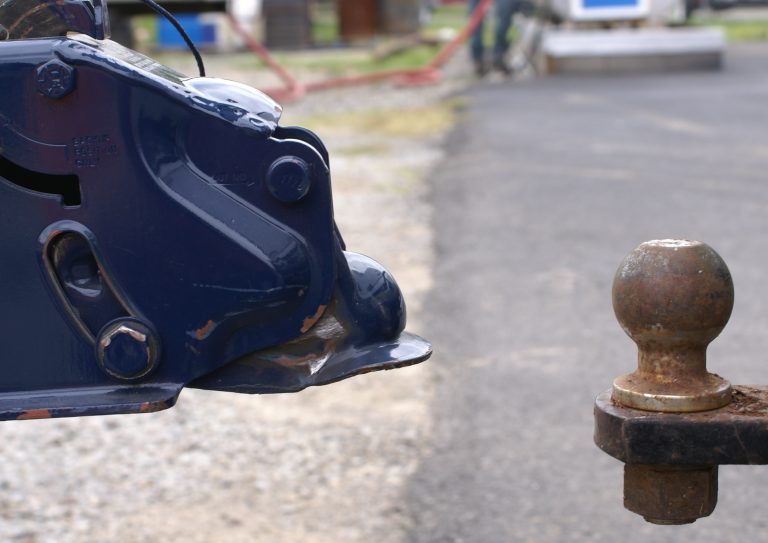
Receiver size is not a cosmetic spec — it’s a direct constraint on how much weight the connection can safely carry. A 1.25″ receiver, typically installed as a Class I or II hitch, is generally rated for a tongue weight in the 200-350 lb range. A 2″ receiver, standard on Class III, IV, and V hitches, scales up substantially: roughly 500-600 lbs on Class III, around 1,000 lbs on Class IV, and 1,200+ lbs on Class V setups.
Every aluminum cargo carrier in this guide is built for a 2″ receiver, and that’s not a coincidence — a fully loaded 500-lb basket would blow past what most 1.25″ receivers are rated to handle, and manufacturers don’t build 500-lb carriers around a 1.25″ shank because it would be a mismatch on the receiver side even before you consider the vehicle’s own tongue weight limit. If your vehicle only has a 1.25″ receiver, adapters exist to step it up to 2″, but the adapter doesn’t raise your vehicle’s underlying tongue weight rating — it just changes the shank size. Check your owner’s manual or hitch installation sticker before assuming an adapter solves the capacity problem.
Hitch Tongue Weight Rating, Explained
Every hitch has two published numbers: a towing capacity (how much a trailer behind it can weigh) and a tongue weight rating (how much downward force can rest directly on the hitch itself, which is exactly what a loaded cargo carrier does). Cargo carrier shopping lives entirely in the tongue weight number, and it’s usually printed on the hitch’s certification label under the bumper or in the vehicle’s towing section of the owner’s manual.
The math buyers skip: your usable capacity is the lower of (a) the carrier’s own weight rating and (b) your vehicle’s tongue weight rating, minus the carrier’s own empty weight. A 500-lb-rated aluminum basket that itself weighs 30 lbs mounted to a hitch rated for 350 lbs tongue weight gives you roughly 320 lbs of actual cargo room — not 500. The chart below shows typical tongue weight ranges by receiver class, based on manufacturer and industry hitch-class references (retrieved August 2026).
Two important caveats: these are typical ranges, not guarantees — the actual number is stamped on your specific hitch, and it varies by vehicle even within the same hitch class. And tongue weight is cumulative: if you’re also running a bike rack or trailer off the same receiver, everything on that hitch shares the one rating.
Folding vs. Fixed Designs
A folding-shank carrier, like the CURT 18100 or the Guide Gear ramp model, pivots up against the bumper when it’s empty. That matters more than it sounds — an unfolded cargo tray hanging 20+ inches behind the bumper blocks the backup camera, obscures the license plate (illegal in most states when unlit or unreadable), and is an easy thing to back into at a curb. Folding designs solve all three by getting the tray out of the way when you’re not actively hauling.
Fixed carriers, by contrast, are simpler and generally a little cheaper, with one less moving joint that can develop play or rattle over years of use. They make sense for anyone who leaves the carrier mounted semi-permanently — overlanders and van lifers who are hauling something on nearly every trip — where the fold-up feature would rarely get used anyway. For occasional use, though, the ability to fold up and reclaim rear visibility is worth the modest price premium most folding models carry.
| Model | Style | Tray/Basket Size | Weight Capacity | Folding | Approx. Price |
|---|---|---|---|---|---|
| CURT 18100 | Flat tray | 60″ x 20″ | 500 lbs | Yes (shank) | ~$197 |
| MaxxHaul 70108 | Deep basket | 49.25″ x 22.5″ x 7.25″ | 500 lbs | No | ~$150-$200 |
| Elevate Outdoor HCCA-2249 | Deep basket | 49.5″ x 22.25″ x 7″ | 500 lbs | No | ~$150-$220 |
| Guide Gear w/ Ramp | Platform + ramp | 50″ x 30.5″ x 6″ | 500 lbs | Yes (shank) | ~$415-$465 |
Frequently Asked Questions
Do I need a 2″ receiver for an aluminum cargo carrier?
For any carrier rated near 500 lbs, yes. Nearly every aluminum basket at that capacity ships built for a 2″ Class III/IV receiver. A 1.25″ receiver’s lower tongue weight rating (typically 200-350 lbs) makes it a mismatch for a fully loaded 500-lb carrier even with a step-up adapter.
What’s the difference between the carrier’s weight rating and my vehicle’s tongue weight rating?
The carrier’s rating is how much the basket itself is engineered to hold structurally. Your vehicle’s tongue weight rating is how much downward force your hitch and frame can safely carry at the receiver. Your real capacity is whichever number is lower, minus the carrier’s own empty weight.
Will an aluminum cargo carrier rust?
Aluminum doesn’t rust the way steel does — it forms a stable oxide layer instead of corroding through. Hardware like bolts, pins, and welds on some models may still use steel components, so check those specific parts if you’re in a heavy road-salt climate.
Can I still see my license plate with a cargo carrier mounted?
Most states require your plate to stay visible and illuminated. An empty folding carrier can be folded up out of the way; a loaded carrier that blocks the plate typically needs a supplemental plate/light mount, sold separately by most of these manufacturers.
How much weight can I actually put in a 500-lb-rated basket?
Only what your vehicle’s hitch tongue weight rating allows, if that number is lower than 500 lbs — which it often is on crossovers and mid-size SUVs. Check your hitch’s certification label before assuming you have the full 500 lbs to work with.
Do these carriers work with a bike rack or trailer on the same hitch?
Not at the same time on the same receiver — a single 2″ receiver holds one accessory at a time. If you need to combine a cargo carrier with towing, everything sharing that hitch has to stay under the combined tongue weight rating.
Is a hitch cargo carrier better than a roof rack for extra capacity?
It depends on the vehicle. Roof racks are capped by the roof’s own static load rating, which is often lower than a hitch’s tongue weight rating — our 4Runner roof rack guide covers a factory cap as low as 165 lbs, for comparison. A hitch carrier is usually the higher-capacity option, but it adds rear length and can affect departure angle off-road, which a roof-mounted or bed-mounted rack doesn’t.
The Bottom Line
An aluminum hitch cargo carrier is worth the price premium over steel mainly for two reasons: it keeps more of your vehicle’s tongue weight budget available for actual cargo, and it won’t rust through at the mounting points the way an unprotected steel weld can. Among the four here, the CURT 18100 is the practical default for flat, bulky loads; the MaxxHaul 70108 and Elevate Outdoor HCCA-2249 add wall height for loose gear; and the Guide Gear ramp model earns its higher price if you’re regularly loading wheeled equipment.
None of that matters, though, until you’ve checked your own vehicle’s hitch tongue weight rating against the carrier’s spec and done the subtraction. That’s a five-minute check against your owner’s manual or hitch certification label, and it’s the step that actually determines how much you can safely haul — not the number printed on the carrier’s box.
If your vehicle’s tongue weight math doesn’t leave much room, it’s worth comparing a hitch carrier against roof- or bed-mounted options for the same trip: see our guides to the Ford F-150 roof rack, Tacoma roof rack, and Tundra bed rack for a sense of how those load ratings compare.