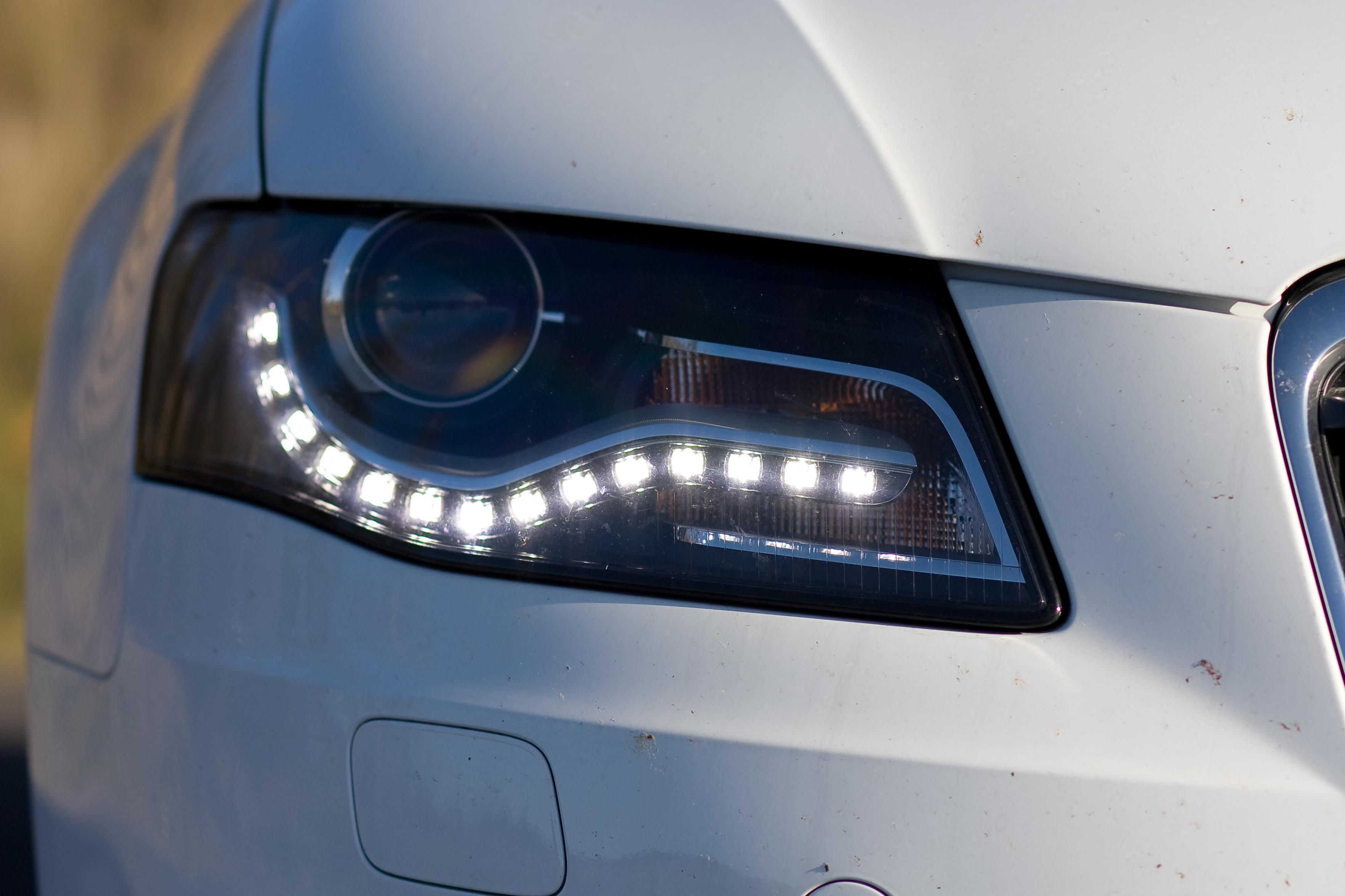
Daytime running lights are not a dimmer version of your headlights, and they are not regulated like headlights either. Under 49 CFR 571.108 (FMVSS 108), the federal standard that governs automotive lamps, DRLs occupy their own photometric category with intentionally lower minimum and maximum intensity limits than low beams, because their job is only to make the front of a vehicle more conspicuous in daylight, not to light the road (eCFR, retrieved August 2026). That distinction matters when you shop for an aftermarket kit, because a well-engineered DRL product is wired to dim or shut off entirely once the actual headlights come on at night, while a cheap kit often just stays lit at full brightness, glaring at oncoming traffic the same way an oncoming car does with its fog lights left on. That single wiring detail, more than LED chip count or lumen claims on the box, is what separates a kit worth installing from one that will earn you flashed high beams on the highway.
This guide covers what to actually look for in an LED DRL kit for 2026: the automatic on/off relay logic that makes a kit legal and courteous to use, how universal strip-style kits differ from vehicle-specific factory-look modules, which color temperatures work best for daytime conspicuity without looking like a blue-tinted gimmick, and which vehicles already come with factory LED DRLs versus which still rely on halogen bulbs wired into a DRL circuit. We also cover install methods, since how a kit is wired affects both legality and long-term reliability more than the hardware itself.
Key Takeaways
- DRLs are a separate FMVSS 108 lamp category from headlights, with their own (lower) intensity limits — they are not designed to illuminate the road (eCFR 49 CFR 571.108, retrieved August 2026).
- A properly wired DRL kit dims or switches off automatically when the headlights are turned on at night; kits without this logic can glare oncoming drivers and are the most common complaint in DIY installs.
- Relay-based “always-on-with-ignition” wiring and dedicated DRL control modules are the two dominant install methods; tapping a parking-light circuit without a control module is the least reliable approach.
- 5000K–6000K white is the practical sweet spot for DRL visibility in daylight; kits pushed toward 8000K+ blue-tinted output trade conspicuity for style and can look dim in bright sun.
- DRLs are not federally mandated in the US the way they are in Canada, the EU, and Australia, so which vehicles have them standard varies a lot by trim, not just by model year.
The DRL Kits Worth Buying
AUXITO Universal LED DRL Kit with Amber Turn Signal
AUXITO’s 7.48-inch flexible light bars are one of the more established universal kits on the market, running a claimed 6000K white output for the daytime running function with a switchback amber mode for turn signals, and the strips mount with either double-sided 3M tape or the included screw hardware for a more permanent install (AUXITO product listing, retrieved August 2026). Because the bars are flexible, they can be shaped to follow a bumper’s contour rather than sitting as a rigid straight bar, which matters on trucks and SUVs with curved lower fascias. Buyers should still add a dedicated relay or controller if the kit doesn’t already include auto-dim logic, since a straight ignition-hot wiring job will leave the white DRL segment on at night unless it’s tied into the headlight circuit.
Best for: owners who want a flexible, contour-hugging DRL strip that doubles as a switchback turn signal.
iJDMTOY Universal LED Daytime Running Light Automatic On/Off Controller Relay
This is not a light kit at all — it’s the wiring brain that a lot of DIY DRL installs are missing. The relay module automatically activates connected LED strips or pods when the engine starts and shuts them off with the key, and higher-end versions include a third wire that ties into the headlight circuit so the DRL output cuts out the moment low beams switch on (iJDMTOY product listing, retrieved August 2026). Pairing a basic universal LED bar with a controller like this is generally the difference between a DRL setup that behaves like a factory system and one that stays on glaring at night.
Best for: anyone adding non-controller LED strips who needs proper automatic on/off and headlight-dependent dimming behavior.
Vehicle-Specific OEM-Style Bumper DRL Modules (Tacoma, F-150, and similar fitment kits)
For popular trucks like the current Toyota Tacoma and Ford F-150, fitment-specific DRL/fog-light-location modules are widely available and designed to bolt into the factory bumper cutout rather than being surface-mounted, which gives a much more OEM appearance than a universal strip (aftermarket fitment listings for 2024-2026 Tacoma and F-150, retrieved August 2026). These typically ship with a plug-and-play harness matched to the vehicle’s existing DRL or fog light wiring, so the automatic on/off and headlight-dimming behavior often comes from the truck’s own body control module rather than an added relay — worth confirming before assuming you need a separate controller.
Best for: Tacoma, F-150, or similar truck owners who want a factory-look DRL that uses the existing bumper cutout and vehicle wiring logic.
DRL vs. Headlight: Why the Regulations Are Different
FMVSS 108 treats DRLs as an optional lamp function with its own photometric table, distinct from the lower-beam and upper-beam requirements that headlights must meet (eCFR 49 CFR 571.108, retrieved August 2026). In practice, this means a legal DRL is deliberately dimmer and narrower in its beam pattern than a headlight — it’s built to catch a driver’s peripheral attention at an intersection or in a mirror, not to light up the pavement 300 feet ahead. Only white or amber output is permitted for DRLs in North America; other colors (blue, red, green) are not compliant regardless of how a kit is marketed (automotive lighting regulatory summaries, retrieved August 2026). This is also why installing a bright “headlight-grade” LED bar and calling it a DRL is a mismatch: it may be legal as an auxiliary light in some jurisdictions, but running it as a daytime conspicuity lamp at headlight-level intensity is exactly the kind of glare source the photometric limits exist to prevent.
Installation Methods: Always-On vs. Auto-Dim-with-Headlights
There are three common ways installers wire aftermarket DRL kits, and they are not equally good:
- Relay to ignition/accessory power (always-on-with-ignition): The simplest method — DRLs come on with the key and stay on until the engine shuts off. Functional, but without an added tie-in to the headlight circuit, the lights will stay at full brightness even after dark, which is the most common source of complaints about aftermarket DRLs glaring oncoming traffic.
- Auto-dim/off controller tied to the headlight circuit: A dedicated control module (like the relay-style products discussed above) monitors the headlight switch and either shuts the DRL segment off or drops it to a dimmed state the instant the driver turns on low beams. This mirrors how factory DRL systems behave and is the setup most likely to pass a casual inspection and avoid complaints.
- Splicing into an existing parking-light or fog-light circuit: Common on vehicle-specific bumper modules, this method borrows the truck’s own body-control-module logic, so the on/off and dimming behavior is inherited from the vehicle rather than added hardware — generally reliable, but it depends entirely on correct wire identification, and a wrong tap can cause flickering or drain the battery with the ignition off.
The practical takeaway: if a kit’s marketing doesn’t mention automatic shutoff or dimming when headlights are on, budget for a separate controller module rather than assuming the strip lights handle it themselves.
Illustrative comparison based on the relative photometric categories described in 49 CFR 571.108; not exact candela values (eCFR, retrieved August 2026).
Color Temperature and Brightness: What Actually Reads as “Daytime White”
Kelvin ratings describe how warm or cool a light source looks, and for DRLs the goal is contrast against daylight, not the whitest or bluest number on the packaging. Daylight itself sits around 5000K–6500K, and most quality automotive LED kits target roughly 5500K–6000K because it reads as clean white without drifting into the visibly blue-purple range that starts around 8000K (LED color temperature guides, retrieved August 2026). Pushing much past 6500K doesn’t make a DRL more visible in bright sun — if anything, heavily blue-shifted LEDs can look weaker in direct daylight than a well-made 6000K unit, because more of the visible spectrum has been shifted away from the wavelengths the eye picks up fastest in bright ambient light. Extremely high-Kelvin kits (8000K and up) are also a common target of state equipment-violation citations because they visually resemble emergency-vehicle lighting or fail the white/amber-only rule for front lamps (automotive lighting regulatory summaries, retrieved August 2026). If a listing doesn’t specify Kelvin at all, or advertises “ice blue” or “diamond white” without a number, treat that as a signal to look elsewhere.
Which Vehicles Already Have Factory LED DRLs
DRLs are not federally mandated in the United States, unlike Canada, the European Union, and Australia, where they are required on new vehicles (Carifex regulatory summary, retrieved August 2026). That means US-market factory DRL equipment is entirely a manufacturer and trim-level choice, and it varies more than shoppers expect. On trucks this site has already covered in detail, the pattern repeats: the Toyota Tacoma’s TRD Off-Road, Limited, and TRD Pro trims get factory LED headlight/DRL assemblies while base SR and SR5 trims do not, and the Jeep Gladiator’s Willys and Sahara trims get LED standard while the base Sport trim is halogen-only unless the Sport S package is added. Ford’s F-150 splits similarly by trim and model year. The practical rule: don’t assume LED DRLs are standard just because a model year is recent — check the trim’s build sheet, because base trims on the same model year frequently still ship with a halogen bulb wired into the DRL circuit rather than a true LED assembly.
| Kit type | Typical install | Auto-dim with headlights | Best for |
|---|---|---|---|
| Universal flexible LED strip | Surface-mount with tape/screws + relay wiring | Only if paired with a controller | Any vehicle, budget-flexible |
| Standalone auto on/off relay module | Spliced into existing lighting harness | Yes, when wired to headlight circuit | Upgrading a non-switching universal kit |
| Vehicle-specific bumper DRL module | Bolts into factory cutout, plug-and-play harness | Usually, via the vehicle’s own body control module | OEM-style look on popular trucks/SUVs |
Frequently Asked Questions
Are aftermarket LED DRL kits legal in the US?
Generally yes, as long as the output is white or amber and the kit doesn’t function as an unauthorized supplemental headlight; FMVSS 108 governs lamp function and photometrics rather than banning aftermarket DRLs outright (eCFR 49 CFR 571.108, retrieved August 2026). Some states add their own equipment rules on top of the federal standard, so it’s worth checking local vehicle code if you’re modifying wiring rather than using a plug-and-play harness.
Do DRLs replace my headlights at night?
No. DRLs are a daytime-only conspicuity function and are not designed to illuminate the road; you still need functioning low beams for night or low-visibility driving. A properly wired kit turns the DRL segment off or dims it specifically because it is not meant to double as a headlight after dark.
Why do some DRL kits glare oncoming traffic at night?
That happens when a kit is wired straight to ignition or accessory power without a headlight-circuit tie-in, so the DRL segment simply stays on at full daytime brightness once it’s dark. It’s the single most common installation mistake with universal kits and the reason a dedicated auto-dim controller is worth the extra cost.
What color temperature should I choose for a DRL kit?
Aim for roughly 5000K–6000K white. That range reads as clean daylight white without the visibly blue cast that shows up around 8000K and higher, and it avoids the white/amber-only compliance issue that overly blue-tinted “ice” kits can run into.
Can I install a DRL kit myself, or does it need a shop?
Most universal strip kits and plug-and-play vehicle-specific modules are DIY-friendly with basic hand tools and a test light, especially with the included wiring harnesses. If you’re splicing into unfamiliar circuits without a harness adapter, or want the auto-dim behavior verified against your specific headlight wiring, having a shop check the install is a reasonable extra step.
Do LED DRL kits draw much power or strain the electrical system?
LED DRLs draw very little current compared to halogen bulbs doing the same job, which is part of why manufacturers moved to LED for this function in the first place — low, continuous draw with minimal heat. A universal LED strip kit is a negligible load on a healthy charging system.
Does every new vehicle in the US come with LED DRLs standard?
No. DRLs themselves are common but not federally mandated in the US, and even when a model offers them, LED versions are frequently reserved for mid- or upper-trim packages, with base trims still using halogen bulbs wired into the DRL circuit. Always check the specific trim’s equipment list rather than assuming by model year alone.
The Bottom Line
The spec sheet numbers on an LED DRL kit’s packaging matter less than one design question: does it turn off or dim when your headlights come on at night? That single feature, driven by how the kit is wired rather than by LED brightness or Kelvin rating, is what separates a DRL setup that behaves like factory equipment from one that annoys every driver you pass after dark. Pair a flexible universal strip or vehicle-specific bumper module with a genuine auto on/off (and ideally auto-dim) relay, keep the color temperature in the 5000K–6000K daylight-white range, and confirm your specific trim’s factory DRL status before assuming you need an aftermarket kit at all — on trucks like the Tacoma, Gladiator, and F-150, that answer changes trim by trim, not just year by year.
If you’re also considering a headlight upgrade alongside DRLs, see our guides to Tacoma LED headlights, Jeep Gladiator LED headlights, and Ford F-150 LED headlights for trim-by-trim factory fitment details, or our breakdown of LED headlight conversion kits if you’re weighing a full headlight swap against just adding a DRL kit.