Most fog light shopping guides spend all their time on color: yellow versus white, selective-yellow Kelvin ratings, whether amber lenses actually help in mist. That’s a real question, and we’ve already answered it in our yellow fog lights guide, which covers the Mie-scattering physics and why the honest case for yellow is glare reduction, not fog penetration. This guide covers a different variable, one that has nothing to do with bulb color: how the light gets shaped and aimed before it ever leaves the housing.
Fog lights split into two optical families. Reflector-style fog lights bounce light off a polished bowl behind the bulb and let it spread out through a clear or lightly fluted lens, the same basic approach used since the sealed-beam era. Projector fog lights add a lens and, critically, an internal shield that blocks part of the reflected light before it exits, carving a sharp horizontal edge into the beam instead of letting it fade out gradually. That shield is the whole story: it’s the same mechanism that gives projector headlights their crisp low-beam cutoff, scaled down and reshaped for a fog light’s wider, flatter pattern. This guide covers real projector fog light products, how that shield actually shapes the beam, and when the extra cost over a reflector fog light is worth paying.
Key Takeaways
- Projector fog lights use a lens plus an internal shield to cut a sharp horizontal line into the beam; reflector fog lights rely on the bowl shape alone and fade out gradually instead.
- The sharp cutoff matters because it keeps light off the underside of the fog bank and out of oncoming drivers’ eyes, instead of scattering upward where it backscatters as glare.
- Reflector fog lights are simpler, cheaper, and easier to source as vehicle-specific drop-ins; projector fog lights cost more and are more often sold as universal or surface-mount pods.
- Beam precision from a projector doesn’t fix a bad aim job — mounting height and vertical adjustment still matter as much as the optic itself.
- Projector fog lights are worth the premium for drivers who log real miles in fog, rain, or heavy traffic at night; reflector fog lights are a reasonable choice for occasional, low-traffic use.
The Fog Lights Worth Buying
Morimoto XB LED Projector Fog Lights — Best Overall
Morimoto’s XB LED fog light line is built around a true projector module rather than a reflector bowl with a projector-style lens glued on for looks. Each housing runs three 5500K LED emitters through internal projector optics that Morimoto states concentrate roughly 2,400 lumens total per pair into a beam engineered for fog light duty: wide, flat, and cut off rather than a generic flood pattern (morimotohid.com, retrieved August 2026). The kits are sold vehicle-specific, plugging into factory fog connectors on dozens of trucks and SUVs, with cast-aluminum housings that double as a heat sink and a 10-year warranty on the LED source.
Best for: owners who want a factory-fit projector upgrade without cutting into bumper openings or rewiring.
Diode Dynamics SS3 Pro SAE Fog Light Kit — Best for Documented Beam Data
Diode Dynamics builds the SS3 around custom-engineered TIR (total internal reflection) optics, a close cousin of true projector optics in that both use a shaped lens element to control where light goes rather than relying on reflector geometry alone. The SAE fog beam option uses FineLine optics for a wide, high-intensity spread with a controlled edge, and Diode Dynamics is one of the few makers that publishes actual SAE photometric test data for its kits instead of leaving beam claims to marketing copy (diodedynamics.com, retrieved August 2026). The Pro tier is rated at roughly 5,796 lumens per pair against the base Sport’s 2,262.
Best for: drivers who want documented, testable beam performance rather than a manufacturer’s word for it.
PIAA LPW530 Wide DRV Kit — Best Switchable Beam Option
PIAA’s LP-series LED lamps use what the company calls Reflector Facing Technology behind the lens to control light output while keeping the beam SAE-Y compliant, and the LPW530 Wide DRV kit adds a wide-pattern option built for fog and low-visibility driving rather than long-range spotting (piaa.com, retrieved August 2026). PIAA also sells a clear/yellow switchable version of this housing, letting one fixture serve as a controlled-beam fog light in bad weather and a wider utility light otherwise.
Best for: drivers who want one housing that covers both a precise fog beam and a general-purpose wide light.
Rigid Industries D-Series Pro — Best Reflector-Style Alternative
Not every fog light needs to be a projector, and the D-Series Pro is the honest reflector-style option worth knowing for comparison. It’s a DOT/SAE J583-compliant surface-mount pod built around an optimized reflector rather than a lens-and-shield assembly, which keeps the price down and the housing simpler to mount on aftermarket bumpers, light bars, or A-pillar brackets where a projector’s flatter housing often doesn’t fit. It won’t match the projector options above for cutoff precision, but it’s a legitimate, street-legal choice where mounting flexibility matters more than beam precision.
Best for: aftermarket bumper and light bar setups where projector housings don’t physically fit.
Projector vs. Reflector Optics, Explained
A reflector fog light is the simpler design: a bulb sits in front of a polished, curved bowl, and the bowl’s shape does essentially all the work of redirecting light forward and spreading it out, with some of that reflected light exiting through a lightly fluted or clear lens with little further shaping. It’s cheap, durable, and well understood, which is why reflector fog lights have been the default since fog lights existed, but the tradeoff is that the beam’s edges fade out gradually rather than stopping cleanly. Light that reflects off the top or sides of the bowl at odd angles tends to scatter upward and outward instead of staying confined to the road surface, which is the source of the “hot spot in the middle, glare at the edges” complaint that comes up constantly in fog light reviews.
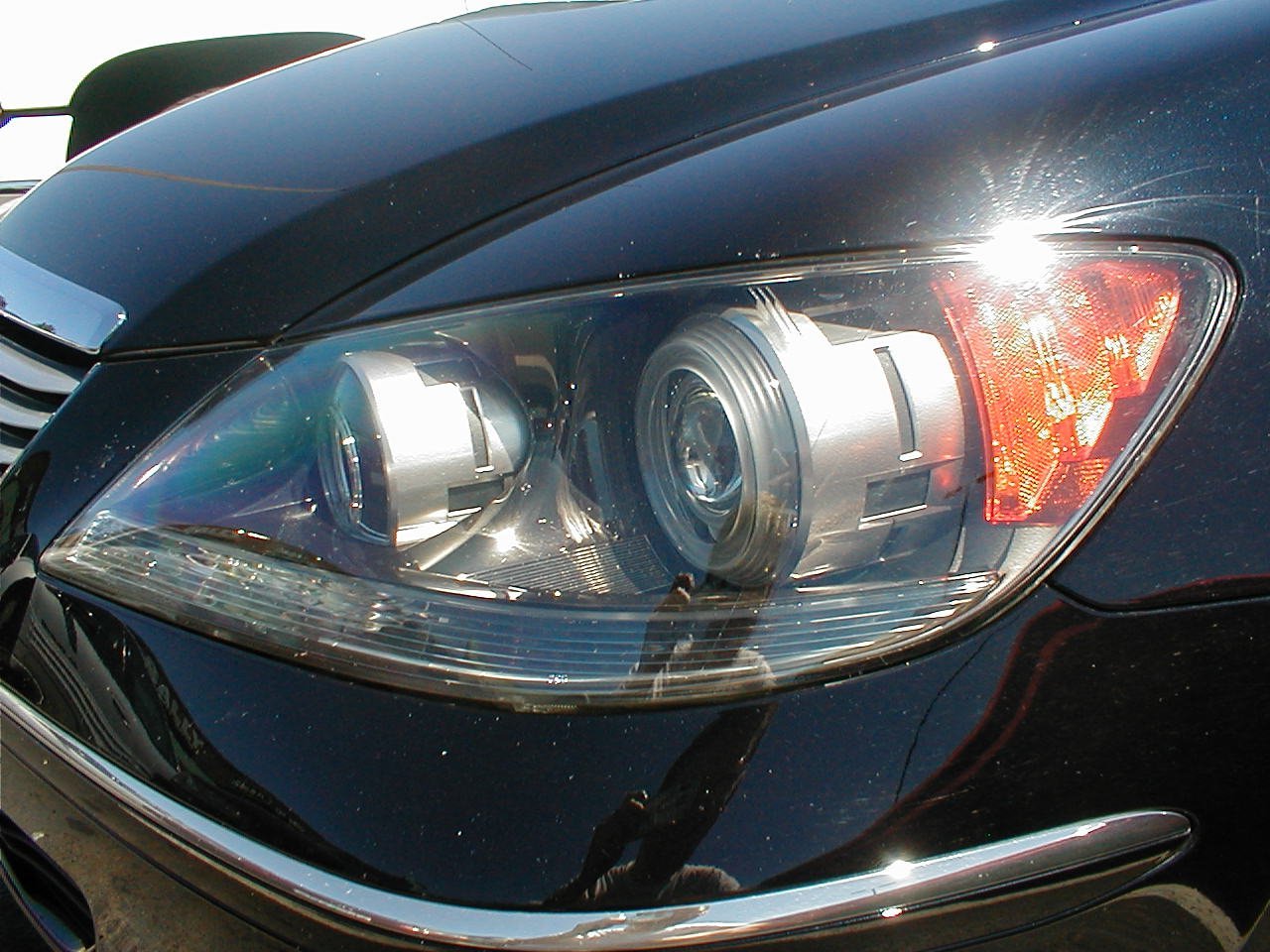
A projector fog light adds two things a reflector doesn’t have: a focused lens at the front, and a shield positioned inside the housing, between the light source and the lens, that physically blocks the portion of the reflected light that would otherwise spill upward. The lens takes what’s left, the light that passed below the shield’s edge, and projects it forward as a tightly controlled beam. The shield’s top edge is what creates the cutoff line; light that would have gone above that line simply never reaches the lens. This is the same principle used in projector headlights to create a sharp low-beam cutoff, applied here to a fog light’s flatter, wider beam shape instead of a headlight’s more forward-throwing pattern.
Why the Cutoff Line Actually Reduces Glare
The cutoff line isn’t just a cosmetic beam shape, it’s doing real optical work. Light that travels above a fog light’s intended aim point does two unhelpful things: it can strike the underside of low-hanging fog or mist and scatter back toward the driver as backscatter glare, and it can travel far enough forward to reach the eye level of an oncoming driver, especially on wet or light-colored pavement that reflects extra light upward. A reflector fog light’s gradual fade has no hard edge to stop that stray light; some fraction of the beam is always leaking above the intended cutoff, just at lower intensity than the main hot spot.
A projector’s internal shield removes that leakage at the source rather than trying to aim around it. Because the shield sits between the reflector and the lens, any light ray that would have exited above the design cutoff angle is physically intercepted before it reaches the lens; the lens only projects light that passed below the shield’s edge. That’s a mechanical guarantee reflector geometry alone can’t match, since a reflector bowl’s shape has to compromise between throwing light forward and controlling spill, while a projector splits those jobs between the reflector (gathering light) and the shield-plus-lens (shaping and cutting it). In practical terms, that means a fog light that lights the road surface and shoulder without throwing much light into the mist above the beam or into an oncoming driver’s windshield.
When Projector Optics Are Worth the Extra Cost
Projector fog lights typically cost more than reflector equivalents, both because the shield-and-lens assembly is more complex to manufacture and because projector kits are more often sold as premium, vehicle-specific products rather than generic pods. Whether that premium is worth paying comes down to how the fog lights get used. Drivers who regularly commute or road-trip through fog, heavy rain, or mixed traffic at night get the clearest benefit: the sharper cutoff means less glare bounced back at them in bad weather, and less glare thrown at oncoming cars, which matters both for courtesy and because a car flashed by an annoyed oncoming driver is a real, if minor, safety distraction.
Occasional users get a weaker case for the premium. A driver who flips on fog lights a handful of times a year in genuinely dense fog, and otherwise leaves them off, is less likely to notice the difference between a soft-edged reflector beam and a crisp projector cutoff. Reflector fog lights are also the more practical choice for off-road-oriented builds where the fog light doubles as a general auxiliary light and mounts in a bumper cutout or light bar location a bulkier projector housing may not fit. In both cases, a well-aimed, SAE/DOT-compliant reflector fog light will outperform a poorly aimed projector unit, so housing type is a real factor, but not the only one.
Mounting Height and Aim Still Decide the Outcome
Optical design only pays off if the fog light is aimed correctly, whether it’s a projector or a reflector. SAE J583, the standard covering fog lamps in the US, generally calls for mounting height between roughly 12 and 30 inches above the road surface with the vehicle at curb weight, low enough to stay under the densest part of a typical fog layer. A projector fog light aimed too high will still throw its sharp cutoff line into oncoming eyes instead of onto the pavement; beam precision doesn’t compensate for bad aim, it just makes the mistake more concentrated instead of gradual. Most vehicle-specific kits, including the Morimoto and PIAA options above, ship with brackets matched to the factory fog light opening’s angle, which removes most of the guesswork; universal pods like the Rigid D-Series require more careful manual aiming, typically checked against a wall at a measured distance per the manufacturer’s instructions.
| Product | Optic type | Light source | Fit | Best for |
|---|---|---|---|---|
| Morimoto XB LED | True projector (lens + shield) | LED, 5500K | Vehicle-specific | Factory-fit projector upgrade |
| Diode Dynamics SS3 Pro SAE | TIR optics with SAE fog beam | LED | Vehicle-specific or universal pod | Documented SAE beam data |
| PIAA LPW530 Wide DRV | Reflector Facing Technology + lens | LED | Universal / vehicle kits | Switchable wide/fog beam |
| Rigid Industries D-Series Pro | Reflector (no shield) | LED | Surface-mount pod | Bumper and light bar builds |
Frequently Asked Questions
What’s the actual difference between a projector fog light and a reflector fog light?
A reflector fog light shapes its beam using only the curved bowl behind the bulb, producing a wide spread that fades out gradually at the edges. A projector fog light adds a lens and an internal shield that blocks the portion of the beam that would otherwise spill upward, producing a sharp horizontal cutoff line instead of a gradual fade.
Do projector fog lights actually reduce glare, or is that marketing?
It’s a real mechanical effect, not just marketing language. The internal shield physically intercepts light rays that would exit above the intended cutoff angle before they reach the lens, so that light never leaves the housing. A reflector has no equivalent mechanism, so more of its beam edge leaks upward at lower intensity.
Are projector fog lights more expensive than reflector fog lights?
Generally yes. The shield-and-lens assembly adds manufacturing complexity, and projector kits are more often positioned as premium, vehicle-specific products. Reflector-style pods remain the cheaper, simpler option and a legitimate choice, particularly for aftermarket bumper or light bar mounting.
Can I put a projector fog light in a housing designed for a reflector?
Not effectively. A projector’s shield, lens, and reflector are designed together as one optical system, and dropping a projector bulb into a housing built for a different beam pattern typically produces uneven, unpredictable output rather than a real cutoff line.
Does beam color (yellow vs. white) matter more or less than projector vs. reflector optics?
They’re separate variables that solve different problems. Beam color affects glare from the light’s own tint and how comfortable the light is to look at or drive behind, which we cover in depth in our yellow fog lights guide. Optical design (projector vs. reflector) affects where the light physically goes. A yellow reflector fog light can still throw stray light upward; a white projector fog light can still be uncomfortably blue-heavy. The two choices are independent of each other.
Do I need a projector fog light if I already have projector headlights?
No, they’re separate systems solving different problems even on the same car. Headlights aim up and out for distance, using a similar shield-and-lens mechanism as described in our H4 headlight bulb guide, while fog lights mount low and aim down and wide to light the road surface under a fog bank. Having projector headlights doesn’t change whether a projector fog light is worth the upgrade.
How do I know if a fog light is a true projector and not just projector-styled?
Check the product description or a teardown photo for an internal shield between the reflector and lens; that shield is the defining component. Some housings use a projector-shaped lens purely for styling without an internal shield, in which case the beam behaves more like a reflector’s gradual fade despite the round lens look.
The Bottom Line
Projector fog lights earn their price premium through a specific, verifiable mechanism: an internal shield that blocks stray light before it reaches the lens, producing a sharper cutoff than a reflector bowl can manage alone. That’s a beam-control upgrade, not a color upgrade, and it stacks independently of the yellow-versus-white question covered in our companion guide. For drivers who spend real time in fog, rain, or mixed night traffic, a true projector kit from a maker like Morimoto or Diode Dynamics is a worthwhile step up; for occasional use or builds where a projector housing won’t fit the mounting location, a compliant reflector pod like the Rigid D-Series Pro remains a legitimate, budget-friendly choice. Whichever type you buy, confirm SAE J583 or DOT certification and get the aim right, since even the sharpest cutoff line only helps if it’s actually pointed at the road.