
The idea that yellow light “cuts through” fog better than white light is one of the oldest pieces of folklore in the automotive world, and it turns out to be mostly wrong for the reason most people think. Fog droplets run from roughly 1 to 100 micrometers across, far larger than any visible wavelength, so the scattering mechanism that colors the sky (Rayleigh scattering, which does treat short wavelengths differently) does not apply. Fog and rain scatter light through Mie scattering instead, a process that is essentially color-blind: a fog droplet bounces yellow light back at the driver about as readily as it bounces blue light back, according to lighting researcher Daniel Stern, whose technical writing on selective yellow is cited by lighting engineers and enthusiast forums alike (danielsternlighting.com, retrieved August 2026).
So why do yellow fog lights still have a loyal following, including an entire country that mandated them for 57 years? The real advantage is physiological, not optical. Blue and violet wavelengths focus slightly in front of the retina rather than directly on it, which blurs the image and adds eye strain, and a 2020s literature review cited by Stern found bluer light sources measured about 46 percent more glaring than yellower ones at equal intensity. Filtering out that short-wavelength content reduces backscatter glare and eases the eye’s workload in rain, snow, and fog, even though it does not let the beam “punch through” mist any better in a strict optics sense. This guide covers the yellow and selective-yellow fog lights actually worth buying in 2026, walks through the color-temperature options on the market, explains the mounting and legal rules that apply in the US, and is honest about where the science is settled and where it is still debated.
Key Takeaways
- Yellow light does not physically penetrate fog better than white light — fog droplets scatter all visible wavelengths roughly equally, since Rayleigh scattering (which favors longer wavelengths) doesn’t apply to particles as large as fog droplets.
- The real benefit of selective yellow is reduced glare and eye strain: short-wavelength blue light focuses slightly ahead of the retina and has been measured as significantly more glaring than yellow light at the same intensity.
- US-market fog lights are legal in either white or selective yellow (SAE J583); blue, purple, red, or green forward-facing auxiliary lights are not street-legal.
- Color temperature options run from roughly 2400-2500K (deep amber, the most filtered) to 3000K (“golden yellow,” a middle ground) up to 6000K white — lower Kelvin means more blue filtered out and more light lost to the filter.
- Fog lights and headlights are separate systems by design: fog lights mount low and aim wide and flat to light the road surface under the fog bank, while headlights aim up and out to project distance down the road.
The Fog Lights Worth Buying
Diode Dynamics SS3 Sport/Pro SAE Fog Light Kit — Best Overall
Diode Dynamics builds its SS3 fog light line specifically around SAE J583 compliance, and the yellow versions run a 3000K “Sport Yellow” LED source through TIR optics designed to reproduce the stock fog beam pattern rather than a generic flood or spot pattern. The company sells vehicle-specific kits with mounting brackets and connectors matched to dozens of trucks and SUVs, which matters more for fog lights than for headlights since factory fog housings vary widely in shape. Diode Dynamics is a US-based company that publishes SAE photometric test data for its fog kits rather than just marketing claims, which is unusual in this category.
Best for: owners who want a factory-look, street-legal yellow fog light with documented beam-pattern compliance.
Rigid Industries D-Series Pro SAE Selective Yellow — Best for Off-Road-Style Housings
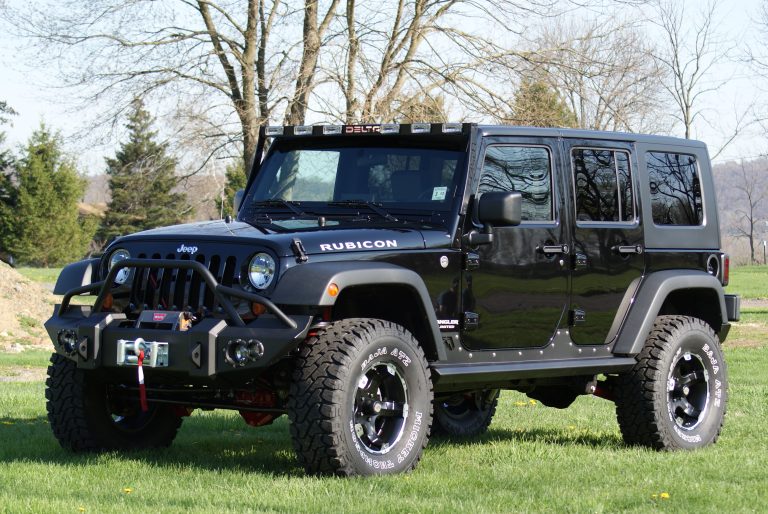
Rigid’s D-Series Pro selective yellow fog light is sold as a DOT/SAE J583-compliant surface-mount pod rather than a vehicle-specific insert, which makes it a common choice for aftermarket bumpers, light bars, and A-pillar mounts on trucks and Jeeps rather than stock fog light cutouts. It uses Rigid’s amber-tinted lens over an LED source to hit selective-yellow chromaticity rather than relying purely on an amber-binned diode, and the housing is rated for off-road vibration and water exposure.
Best for: truck and Jeep owners running aftermarket bumpers or light bars who still want to stay street-legal.
PIAA LP530 Ion Yellow LED Fog Light Kit — Best Deep-Amber Option
PIAA’s LP530 runs at approximately 2500K, noticeably deeper amber than the 3000K “golden yellow” kits above, using two 8-watt LEDs behind a multi-surface reflector rather than a single high-output emitter. PIAA has sold ion-crystal-coated yellow lenses and bulbs since the halogen era (its 520 and 540 Ion Yellow kits are still sold as halogen upgrades for owners who haven’t converted to LED fog housings), and the LP530 is the LED continuation of that lineup with far lower current draw than the halogen originals.
Best for: drivers who want the deepest, most classically “French yellow” beam color rather than a lighter gold tone.
KC HiLiTES FLEX ERA 3 Dual Mode (Clear + Yellow Lens) — Best for Switching Colors
Rather than committing to one color permanently, KC HiLiTES sells the FLEX ERA 3 with swappable clear and yellow lens covers, so the same housing can run white for clear-night visibility and yellow for fog, rain, or dusty conditions. This is the practical answer for drivers who read the mixed research on yellow-versus-white and don’t want to bet on one side: the lens swap takes a few minutes and doesn’t require rewiring or a second light.
Best for: drivers who want to test both colors on their own vehicle instead of taking a manufacturer’s word for it.
The Glare-Scatter Physics, Explained Honestly
The claim that yellow light “cuts through fog” usually gets attributed to the same physics that makes the sky blue, but that comparison doesn’t hold up. Rayleigh scattering, which does scatter shorter (bluer) wavelengths more strongly, only dominates when the scattering particles are much smaller than the wavelength of light — that’s true of nitrogen and oxygen molecules in clear air, but not of fog. Fog droplets range from about 1 to 100 micrometers in diameter, which is 2 to 3 orders of magnitude larger than the roughly 400-700 nanometer wavelength of visible light. At that size ratio, Mie scattering takes over, and Mie scattering treats the visible spectrum far more evenly — a fog droplet reflects yellow and blue light back toward the driver at broadly similar intensities.
What yellow light does change is how much of that backscattered glare the human eye finds tolerable. Short-wavelength blue and violet light suffers more from chromatic aberration in the eye, focusing slightly in front of the retina rather than directly on it, producing a soft blur and added eye strain in exactly the low-contrast conditions where drivers most need sharp edges. Selective yellow removes most of that blue-violet content by design (the filtered color approximates hex #FFBA00), and Stern’s technical writeup cites measurements putting bluer light sources at roughly 46 percent more glaring than yellower ones at matched intensity (danielsternlighting.com, retrieved August 2026). That’s a real, measurable advantage — a glare-and-comfort advantage, not a fog-penetration advantage, and the two get conflated constantly in marketing copy.
The controlled research on crash outcomes is genuinely mixed. A UK study from 1968 measured about 3 percent better visual acuity with selective yellow versus white headlamps at equal intensity. A 1976 Dutch study concluded yellow and white headlamps were essentially equivalent for safety, while separately noting yellow caused less discomfort glare. A later British Road Research Laboratory study reportedly found yellow measured about 2.5 percent worse for visual clarity than white. None of these settle the question, and the honest summary is that selective yellow has been subjectively preferred by experienced drivers in bad weather for generations, without the objective safety case ever being conclusively proven either way.
Color Temperature Options Compared
“Yellow fog light” isn’t one product — it spans a range of color temperatures, and the number tells you how much blue content has been filtered or omitted from the source. Lower Kelvin numbers mean warmer, more amber-shifted light and less blue content; higher Kelvin numbers mean whiter or bluer light.
Products like the PIAA LP530 sit at the deep-amber end, around 2500K, closest to the classic French selective-yellow look and the most aggressively filtered. Diode Dynamics and Rigid kits typically land at 3000K, marketed as “golden yellow,” keeping more light output while still filtering most of the blue-violet band. Bulbs marketed as “amber” but running closer to 3500K read more like warm white than true selective yellow. Standard white LED and HID products run 5000-6500K, and factory halogen bulbs measure around 3000-3200K despite looking “white” to most drivers — part of why some enthusiasts argue halogen fog lights already carry a mild yellow cast without any filtering.
Mounting Height, Aim, and Legal Considerations
In the US, fog lights fall under SAE standard J583, which the National Highway Traffic Safety Administration has incorporated into FMVSS 108. That standard permits either white or selective yellow output for forward fog lamps; blue, purple, red, or green are not legal for forward-facing auxiliary lighting on public roads. Mounting height requirements generally place fog lights between 12 and 30 inches above the road surface, measured with the vehicle at curb weight — low enough to sit under the densest part of a fog bank, which typically hugs the ground.
Beam pattern matters as much as color. SAE J583 fog beams are supposed to be wide and flat with a sharp horizontal cutoff, spreading light across the road surface and shoulder without throwing it upward into oncoming drivers’ eyes or reflecting off the fog bank itself. That’s why aftermarket pods sold as generic “off-road lights” without SAE/DOT certification are a common source of citations and failed inspections even when their color is legal — beam pattern, not just tint, is what regulators check. Most states also require fog lights to run independently of high beams and switch off automatically when high beams engage, since a wide fog beam adds nothing at high-beam distances and mostly adds glare.
Fog Lights vs. Headlights: Two Different Systems
Color is only one axis of this category; the beam’s optical design (projector-style lens-and-shield versus a plain reflector bowl) is a separate variable that affects glare and beam control independently of tint, covered in our projector fog lights guide.
It’s worth being explicit that fog lights and headlights solve different problems and are not interchangeable, regardless of color. Headlights are designed to throw light forward and slightly upward, prioritizing distance down the road — that’s the beam pattern discussed in our guide to headlight bulbs for night driving, where IIHS data shows low-beam reach varying from 125 to 460 feet depending on the headlight system. Fog lights do the opposite: mounted low and aimed down and wide, their job is to light the road surface and edges directly in front of the car without throwing light up into the fog bank, where it would scatter back at the driver as glare regardless of color.
That’s also why fog lights are a poor substitute for a real headlight upgrade. Drivers looking to improve overall low-beam output are better served by starting with a correctly shielded bulb — our H4 headlight bulb guide covers why shield geometry, not just brightness, determines whether a headlight blinds oncoming traffic — or, where the vehicle supports it, a certified LED system like the ones covered in our LED headlight conversion kit guide. Fog lights supplement that system in specific weather; they don’t replace it.
| Product | Color temp | Light source | SAE/DOT compliant | Best for |
|---|---|---|---|---|
| Diode Dynamics SS3 Sport/Pro | 3000K | LED | Yes | Factory-look, vehicle-specific fit |
| Rigid Industries D-Series Pro | Selective yellow (lens-filtered) | LED | Yes | Aftermarket bumpers and light bars |
| PIAA LP530 Ion Yellow | 2500K | LED | Manufacturer-stated | Deepest amber color |
| KC HiLiTES FLEX ERA 3 Dual Mode | Switchable (clear/yellow lens) | LED | Yes | Testing both colors on one housing |
Frequently Asked Questions
Do yellow fog lights actually work better in fog than white ones?
Not in the sense of penetrating fog physically — fog droplets scatter yellow and white light at broadly similar rates because they’re far larger than any visible wavelength. Yellow’s real advantage is reduced glare and eye strain from filtering out blue-violet content, which many drivers experience as “seeing better,” even though the mechanism isn’t literal fog penetration.
Is it legal to run yellow fog lights in the US?
Yes. SAE J583, which FMVSS 108 incorporates, permits both white and selective yellow for forward fog lamps. Blue, purple, red, and green are not legal for forward-facing auxiliary lights.
What color temperature counts as “true” selective yellow?
There’s no single number, but products marketed as selective yellow or “Ion Yellow” typically fall between roughly 2400K and 3000K. Products above about 3500K read more like warm white than true yellow, since much less blue content has been filtered out.
Can I install aftermarket LED fog lights in my factory fog housings?
Sometimes, if the manufacturer sells a kit specifically shaped and wired for your vehicle’s stock housing. Generic amber LED bulbs dropped into a factory reflector housing designed for halogen will usually scatter light unevenly and can fail SAE beam-pattern requirements even though the bulb itself is legal.
Why did France require yellow headlights for so long?
France mandated selective yellow for all road-illumination lamps, including headlights, starting in 1936-1937, based on early studies suggesting it reduced glare and modestly improved visual acuity. The requirement stayed in place until 1993, when EU-wide lighting regulations (which favor white) superseded French national law.
Do yellow fog lights reduce glare for oncoming drivers, or just for the driver using them?
Both, to some degree. Filtering blue-violet wavelengths reduces the glare the light source itself produces for oncoming traffic, and it also reduces the backscatter glare that bounces into the eyes of the driver using the lights, since less blue content means less light for the eye to struggle focusing.
Should I replace my white fog lights with yellow ones?
If you drive frequently in fog, heavy rain, or snow and find white fog lights uncomfortable or glary in those conditions, a selective-yellow swap is a reasonable, inexpensive change — several kits above are direct-fit for common fog housings. If your fog lights are rarely used, the upgrade is a comfort preference rather than a necessity, since the underlying research on objective safety benefit is mixed.
The Bottom Line
Yellow fog lights are a real product category with a defensible, if narrower-than-advertised, rationale: they don’t cut through fog any better in a strict optical sense, but they cut the blue-heavy glare that makes fog, rain, and snow driving fatiguing, and that’s a genuine, measurable difference in how comfortable the light is to drive behind. Anyone shopping this category should treat the color-temperature number as more useful than the marketing copy — a 2500K PIAA kit and a 3000K Diode Dynamics kit are both “yellow,” but they filter noticeably different amounts of blue, and a 3500K “amber” bulb is closer to warm white than true selective yellow. Whichever kit you choose, confirm it carries SAE J583 or DOT certification rather than just an amber tint, since the beam pattern and mounting height matter as much as the color for staying both legal and actually useful in the conditions these lights are built for.