
A wall-mounted tire storage rack protects what’s often a genuinely significant investment — a seasonal or spare tire set commonly represents $600 to $1,200 — while reclaiming real floor space, with a properly mounted rack capable of freeing up to 25 square feet of garage floor that stacked tires would otherwise occupy (Garage World 360, retrieved 2026-08-10). Choosing between a basic budget wall mount and a professional-grade rack comes down to weight capacity and mounting security more than any other factor.
This guide covers the tire storage racks worth buying in 2026, why wall-mounted storage protects tires better than stacking them on the floor, what weight capacity and stud-mounting requirements to check before buying, and how to choose between a fixed wall rack and a folding or rolling alternative.
Key Takeaways
- A wall-mounted tire rack can reclaim up to 25 square feet of garage floor space compared to stacking tires directly on the ground.
- Seasonal or spare tire sets commonly represent a $600-$1,200 investment, making proper storage a real cost-protection decision, not just tidiness.
- SafeRacks offers professional-grade construction with the highest weight capacity in most comparisons, at a corresponding premium price.
- Budget options, like basic Amazon wall mounts, commonly run around $50 and perform solidly once properly mounted to wall studs.
- Folding tire racks, like the Angel Sar Max at $155.99, offer a middle ground between budget wall mounts and premium fixed systems.
The Tire Storage Racks Worth Buying
SafeRacks Wall Mount Tire Rack
SafeRacks builds professional-grade tire storage with the highest weight capacity commonly found in this category, aimed at buyers who want maximum confidence in a permanent wall installation (SafeRacks, retrieved 2026-08-10).
Best for: buyers wanting maximum weight capacity and confidence in a permanent, heavy-duty installation.
Budget Wall Mount (HyLoft, VEVOR, and similar)
For storing seasonal tires for a single vehicle, an affordable wall mount option performs solidly once properly mounted to studs, commonly priced around $50 (Garage World 360, retrieved 2026-08-10).
Best for: single-vehicle households storing one seasonal tire set on a budget.
Angel Sar Max Folding Tire Wheel Rack
Priced at $155.99, this folding wall-mount rack offers a middle ground between minimal budget mounts and premium fixed systems, with a folding design for when the rack isn’t loaded (Home Depot, retrieved 2026-08-10).
Best for: buyers who want a mid-tier rack that folds flat against the wall when not storing tires.
Why Wall-Mounted Storage Beats Stacking on the Floor
Tires stacked directly on a garage floor sit in prolonged contact with concrete, which can trap moisture against the rubber and lead to flat-spotting or uneven wear over a long storage period, particularly in a garage with any humidity or temperature swings. A wall-mounted rack keeps tires elevated and allows airflow around the full circumference of each tire, reducing that moisture-contact risk while also keeping them out of the way of parked vehicles, foot traffic, and anything else stored at floor level. Given that a seasonal tire set represents a genuine several-hundred-dollar investment, the modest cost of a proper rack is small relative to protecting that investment’s condition and lifespan.
Weight Capacity and Stud Mounting: What to Check First
A tire rack’s rated weight capacity needs to cover your specific tire and wheel combination’s total weight, not just the tire alone — a mounted wheel-and-tire assembly, especially on a larger truck or SUV, can weigh considerably more than the tire by itself, and undersizing the rack’s capacity risks a mounting failure under load. Equally important is confirming the rack mounts to actual wall studs rather than drywall alone, since drywall anchors are not rated to hold the sustained weight of multiple mounted tires safely over time. Locate your garage wall’s stud spacing before buying, and confirm the rack’s mounting hole pattern matches standard stud spacing (typically 16 inches on center) for a secure, stud-anchored installation.
Fixed vs. Folding: Which Suits Your Garage
A fixed wall rack, generally the simplest and often least expensive option, stays permanently extended from the wall whether loaded or not, which is fine in a garage with generous space but can become an obstacle in a tighter layout. A folding rack, like the Angel Sar Max, collapses flat against the wall when empty, reclaiming that space during the months tires aren’t in seasonal storage. The tradeoff is usually a modest price premium and, in some designs, a slightly lower maximum weight rating than an equivalent fixed rack, since the folding mechanism itself takes up some of the structural budget that a fixed design puts entirely into load capacity.
How Many Tires Does Your Household Actually Need to Store
Households running a seasonal tire swap for one vehicle typically need capacity for four tires, while multi-vehicle households or anyone keeping a spare full set on hand may need a rack rated for six or eight. Buying a rack sized for your actual maximum simultaneous storage need avoids both an undersized rack straining at capacity and an oversized rack taking up more wall space than necessary. If your storage needs are likely to grow (adding a second vehicle, switching to a larger tire size), consider sizing up slightly rather than needing a second rack purchase later.
Tire Storage Position: Vertical vs. Horizontal Hanging
Most wall-mounted racks store tires vertically, hanging from a horizontal arm through the wheel’s center bore or resting against a set of vertical pegs, which is the standard and generally recommended orientation for longer-term storage since it minimizes prolonged flat-spot pressure on any single point of the tire’s contact patch. Horizontal stacking, whether on the floor or on a shelf-style rack, distributes weight differently and can be more prone to flat-spotting over extended storage periods, particularly with heavier tire and wheel combinations. If your rack offers a choice between orientations, vertical hanging is generally the better default for tires that will sit in storage for a full season rather than just a few weeks.
Installation and Long-Term Care
Confirm stud locations with a stud finder before drilling, and use the mounting hardware specified by the manufacturer rather than substituting shorter or thinner screws that may not penetrate the stud deeply enough for a secure hold. Once installed, periodically check the mounting hardware for any sign of loosening, particularly after the rack has held a full load through a temperature-swing season, since wood studs can shift slightly with humidity changes over time. Clean tires before storing them long-term, since dirt and brake dust left on a tire during storage can bond to the rubber surface over months, making cleanup harder once the tires go back into use.
Rolling and Freestanding Alternatives
For garages where drilling into walls isn’t an option, such as a rental property, a freestanding or rolling tire rack offers an alternative that still lifts tires off direct floor contact without any permanent installation. These typically have a lower maximum capacity than a properly stud-mounted wall rack and take up floor space rather than reclaiming it, but they remain a reasonable option when wall-mounting genuinely isn’t possible. If you eventually move to a property where wall-mounting is an option, transitioning to a stud-mounted rack is usually worth the upgrade for the additional floor space it reclaims.
Labeling and Organization for Multiple Sets
If you’re storing more than one tire set — summer and winter sets, or tires for multiple vehicles — labeling each tire with the vehicle, position (front-left, rear-right, etc.), and the date it went into storage saves real time and confusion at the next seasonal swap. A simple grease pencil or paint marker on the sidewall, or a tag looped through the wheel, works fine for this purpose. This becomes especially valuable if you’re not the only person who might pull tires off the rack, since a labeled set removes any guesswork about which tire goes where.
Frequently Asked Questions
Is a wall-mounted tire rack worth it over just stacking tires?
Given that a seasonal tire set often represents a $600-$1,200 investment, the modest cost of a rack that protects tire condition and reclaims floor space is generally a worthwhile purchase, not just a tidiness upgrade.
Do tire racks need to mount to wall studs?
Yes. Drywall alone isn’t rated to hold the sustained weight of mounted tires safely. Confirm stud locations and use the manufacturer’s specified mounting hardware for a secure installation.
How much weight can a typical tire rack hold?
It varies significantly by model, from basic budget mounts to SafeRacks’ professional-grade, higher-capacity systems. Check the rack’s rated capacity against your specific wheel-and-tire assembly weight, not just the tire alone.
What’s the difference between a fixed and folding tire rack?
A fixed rack stays permanently extended from the wall; a folding rack collapses flat when empty to reclaim space. Folding designs typically cost more and may have a slightly lower maximum weight rating than an equivalent fixed rack.
Should tires be stored vertically or horizontally?
Vertical hanging is generally the better default for extended seasonal storage, since it minimizes prolonged flat-spot pressure compared to horizontal stacking. Most wall-mounted racks are designed around vertical storage for this reason.
Garage Ceiling and Overhead Storage Alternatives
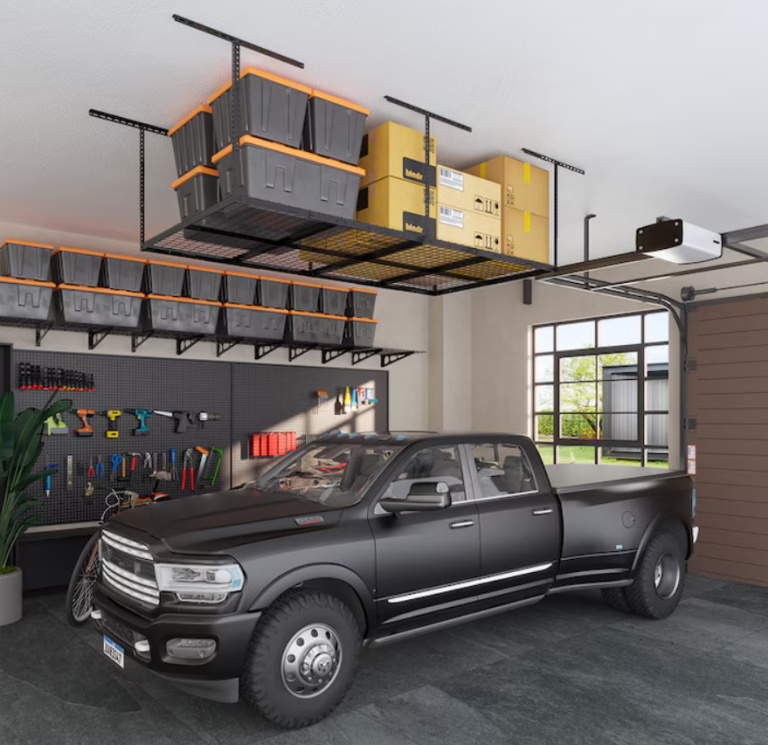
For garages with more overhead clearance than wall space, a ceiling-mounted hoist or platform system offers another way to get tires off the floor without consuming wall real estate, though these systems generally cost more and require confirming your garage ceiling’s joist spacing and load rating before installation. Wall-mounted racks remain the more common and cost-effective choice for most home garages, but a ceiling system is worth considering specifically if wall space is already committed to shelving, a workbench, or other storage and overhead clearance is genuinely underused.
The Bottom Line
A wall-mounted tire rack protects a genuine several-hundred-dollar seasonal tire investment while reclaiming meaningful garage floor space. Confirm stud-mounting compatibility and weight capacity against your actual wheel-and-tire weight before buying, and choose a folding design like the Angel Sar Max if garage space is tight, or a fixed SafeRacks-style system if maximum capacity and permanence matter more than reclaiming wall clearance.