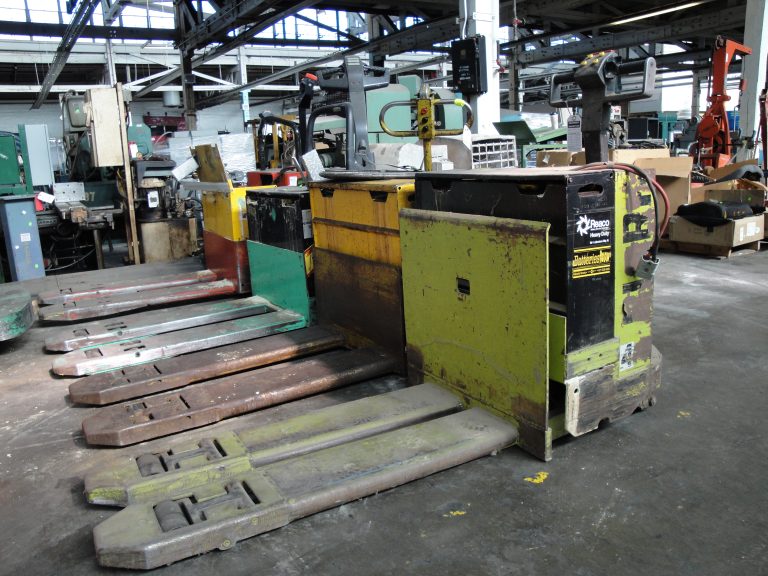

The average warehouse counterbalance forklift weighs somewhere between 8,000 and 15,000 lbs empty, before you even factor in the counterweight built into IC (internal combustion) models to offset a raised load. That number is the reason a 3-ton automotive floor jack has no business anywhere near a forklift’s drive axle. A forklift jack is a different category of tool entirely: a low-profile hydraulic bottle jack rated 10,000 lbs and up, built to slide under a chassis with only a few inches of ground clearance and hold that weight steady while a tire, hub, or hydraulic line gets serviced. It is not to be confused with a pallet jack (like the ones covered in our Best Electric Pallet Jack and Best Manual Pallet Jack guides) — a pallet jack moves palletized freight horizontally across a warehouse floor, while a forklift jack lifts the forklift itself off the ground for maintenance. Same word, completely different job.
Key Takeaways
- Forklift jacks need a minimum 10-ton rating, and most shops standardize on 20-ton units since a fully loaded counterbalance forklift can exceed 15,000 lbs on one end alone.
- Low collapsed height (roughly 9-11 inches) matters more than raw capacity for most forklifts, since chassis clearance under the drive axle is often under a foot.
- Air/hydraulic combo jacks lift in seconds off a shop air line, while pure hydraulic (hand-pump) models cost less but take dozens of pump strokes to reach full height.
- A forklift jack should never be the only thing holding the machine up — pair it with jack stands rated for the same load before anyone works underneath.
- 20-ton and 30-ton models from Norco, OTC, Esco, AFF, and Blackhawk cover nearly every Class I-V forklift in a typical fleet maintenance bay.
Why Forklift Jacks Need Serious Capacity and a Low Profile
Two specs separate a forklift jack from every other bottle jack in a shop: capacity and collapsed height, and both come from the same source — forklifts are built low and heavy. A Class IV or V internal-combustion forklift concentrates most of its weight over the drive axle and counterweight, which means the jack isn’t just lifting a share of a 9,000 lb machine, it’s often supporting several thousand pounds at a single contact point. That’s why 10-ton is treated as an absolute floor in this category and most commercial shops run 20-ton or 30-ton units instead, the same jump in capacity class covered in our Best 50 Ton Bottle Jack guide for even heavier industrial and shop-press work.
Collapsed height is the spec that actually decides whether a jack works at all. A standard automotive bottle jack collapses to 9-10 inches, which sounds low until you’re trying to slide it under a forklift’s counterweight frame or between the drive axle and the mast rails, where clearance is frequently under 8 inches. Forklift-rated low-profile jacks are engineered specifically to collapse shorter — often in the 8.5-10 inch range — while still extending 16-20 inches to get real lift height for tire, hub, and brake work. Air/hydraulic combo units add a second advantage: connect a shop air line and the ram races up in seconds instead of the 20-40 pump strokes a manual hydraulic jack needs to reach the same height, which matters when a fleet bay is cycling multiple forklifts through service in a shift.
Capacity and collapsed height only solve half the problem. OSHA’s guidance on powered industrial truck maintenance is explicit that a forklift must never be worked on while supported only by a jack — the hydraulic seal is a wear item, not a locking mechanism, and a slow leak or a bumped release valve can drop a load with no warning. Every forklift jack in this guide should be paired with jack stands rated to match or exceed its capacity before anyone puts a hand or a body part underneath the machine. Our Best 10 Ton Jack Stands guide covers stands built for exactly this kind of commercial, fleet-grade load, and the Best Heavy Duty Jack Stands guide covers the 6-ton class if you’re working lighter electric or narrow-aisle units.

The Best Forklift Jacks Worth Buying
The seven jacks below cover the two capacity tiers that handle almost every forklift a shop will see: 20-ton units for the bulk of Class I-III electric and narrow-aisle trucks, and 30-ton units for heavier Class IV-V internal-combustion and rough-terrain forklifts. All are low-profile designs meant to fit under the tight chassis clearance these machines are known for.
Norco 76957A 20-Ton Low Profile Air/Hydraulic Bottle Jack
Norco’s 76957A is a fixture in commercial fleet bays because it splits the difference between speed and simplicity — connect shop air for a fast lift, or fall back to the manual handle if the air line is busy elsewhere. Collapsed height sits around 9.75 inches with roughly 18 inches of travel, enough clearance for most counterbalance forklift axles. Pricing typically runs $440-$480.
Best for: shops that want air-assist speed without giving up a manual backup.
OTC 5150A 20-Ton Low Profile Air/Hydraulic Bottle Jack
OTC’s 5150A is built around a wider base plate than most 20-ton competitors, which matters when you’re jacking on uneven shop floor or slightly angled forklift frames. It’s a dealer-service-department staple, rated for repeated daily cycling rather than occasional use. Expect to pay $490-$540.
Best for: dealer and rental-fleet service departments running back-to-back lifts all day.
Esco 10495 20-Ton Low Profile Air/Hydraulic Bottle Jack
Esco’s line skews toward heavy commercial and industrial buyers, and the 10495 keeps the same rugged build quality at a lower price point than Norco or OTC. It trades a bit of finish and a slightly taller collapsed height (around 10.5 inches) for savings that add up when a shop needs two or three units. Typically $410-$450.
Best for: budget-conscious independent shops that still need commercial-grade reliability.
AFF 3620LP 20-Ton Low Profile Hydraulic Bottle Jack
AFF’s 3620LP is a pure manual hydraulic unit with no air-assist option, which keeps the price down and removes one more thing that can fail on an air line. It’s a reasonable choice for shops that don’t lift forklifts often enough to justify the air-assist premium. Pricing runs $370-$410.
Best for: lower-volume shops that don’t need air-assist speed and want to save on upfront cost.
Norco 78257A 30-Ton Low Profile Air/Hydraulic Bottle Jack
Stepping up to 30 tons, the 78257A is sized for heavier IC counterbalance and rough-terrain forklifts where a 20-ton unit’s margin gets thin. It keeps a similar collapsed-height profile to Norco’s 20-ton model despite the added capacity, which is the harder engineering trick in this class. Expect $650-$700.
Best for: heavier Class IV-V internal-combustion and rough-terrain forklifts.
OTC 5170A 30-Ton Air/Hydraulic Bottle Jack
OTC’s 30-ton entry mirrors the 5150A’s wide-base design at a higher capacity tier, and it’s commonly specified in fleet maintenance bays that service a mixed lineup — narrow-aisle electrics one day, IC counterbalance units the next. Pricing typically lands at $700-$750.
Best for: fleet maintenance bays servicing a mix of forklift classes on one jack.
Blackhawk B6350 20-Ton Air/Hydraulic Bottle Jack
Blackhawk (an SPX brand) shows up often in shops already standardized on SPX/OTC air tooling, and the B6350 shares service parts and seal kits with that ecosystem — a real advantage for a fleet that wants to minimize the number of spare-parts SKUs it stocks. Runs $450-$500.
Best for: shops already standardized on Blackhawk or SPX air tooling and parts.
| Model | Capacity | Collapsed Height | Lift Type | Approx. Price |
|---|---|---|---|---|
| Norco 76957A | 20 ton | ~9.75 in | Air/Hydraulic | $440-$480 |
| OTC 5150A | 20 ton | ~9.5 in | Air/Hydraulic | $490-$540 |
| Esco 10495 | 20 ton | ~10.5 in | Air/Hydraulic | $410-$450 |
| AFF 3620LP | 20 ton | ~9.75 in | Manual Hydraulic | $370-$410 |
| Norco 78257A | 30 ton | ~10.25 in | Air/Hydraulic | $650-$700 |
| OTC 5170A | 30 ton | ~10 in | Air/Hydraulic | $700-$750 |
| Blackhawk B6350 | 20 ton | ~9.5 in | Air/Hydraulic | $450-$500 |
Capacity is only useful if the jack actually fits under the machine. The chart below lines up collapsed height against rated capacity — the goal is a jack in the bottom-left area of the field, low enough to slide under a tight chassis while still rated high enough for the load.
A few things separate a jack that lasts through years of daily fleet use from one that starts weeping fluid after a season. Look for a two-piece pump handle on air/hydraulic models — it stores flat and reaches into tighter service bays than a single fixed handle. Check the base plate width relative to the jack’s own height; a wider base resists tipping on the slightly uneven concrete common in older warehouses. And confirm the release valve has a clearly marked, separate control from the pump handle, since fumbling for the release under a loaded machine is exactly the kind of mistake OSHA’s maintenance guidance is written to prevent. Most of these jacks ship rated to ANSI/CE standards, which covers minimum build quality, but rated standards don’t substitute for routine inspection — check the ram for pitting, the seals for weeping fluid, and the base for cracks before every use, not just annually.

FAQ
What capacity jack do I need to lift a forklift?
10 tons is the absolute minimum for most electric warehouse forklifts, but 20 tons is the practical standard because it leaves margin for the counterweight concentration in IC counterbalance models. If your fleet includes anything in the 15,000+ lb class, step up to a 30-ton unit.
Can I use a regular automotive floor jack on a forklift?
No. Standard automotive floor jacks top out around 3-5 tons, far below what a forklift’s axle load requires, and their collapsed height is often too tall to clear the chassis anyway. Use a jack purpose-rated for the load and clearance, not whatever is already in the shop.
Do I still need jack stands if I’m using a heavy-duty bottle jack?
Yes, always. A bottle jack is a lifting tool, not a support tool, and OSHA’s forklift maintenance guidance treats working under a jack-only-supported machine as an unacceptable risk. Pair the jack with stands rated to the same or higher capacity, such as those in our Best 10 Ton Jack Stands guide.
What’s the difference between a forklift jack and a pallet jack?
A forklift jack lifts the forklift itself off the ground so a technician can service tires, hubs, or hydraulics underneath it. A pallet jack does the opposite job entirely — it’s a wheeled tool that lifts and moves loaded pallets horizontally across a floor, covered separately in our Best Electric Pallet Jack and Best Manual Pallet Jack guides.
Air/hydraulic or pure hydraulic — which is worth the extra cost?
Air/hydraulic combo jacks lift in seconds off a shop air line and are worth the premium in any bay that services more than a couple of forklifts a week. A pure manual hydraulic jack is a reasonable choice for low-volume or occasional use, where the time savings don’t offset the added cost.
How often should a forklift jack be recertified or replaced?
There’s no fixed federal recertification interval for a bottle jack the way there is for lifting slings or cranes, but most manufacturers recommend a full seal and fluid inspection annually for jacks in daily commercial use, and immediate retirement of any unit that shows fluid weeping, a bent ram, or a base that no longer sits flat. If a jack has ever been dropped, dragged, or used past its rated capacity, treat it as suspect and replace it rather than guessing at its remaining service life.
The Bottom Line
Forklift jacks live in a narrow but well-defined niche: enough capacity to handle axle loads a passenger-vehicle jack was never built for, and a collapsed height low enough to actually fit under the machine. For most fleets, a 20-ton air/hydraulic unit like the Norco 76957A or OTC 5150A covers the bulk of the work, with a 30-ton step-up like the Norco 78257A or OTC 5170A held in reserve for heavier IC counterbalance and rough-terrain units. Whatever capacity you land on, treat the jack as a lifting tool only — pair it with rated jack stands before anyone works underneath, and keep the pallet jack in a completely separate category in your head, because the two tools don’t overlap at all despite the name.