
By late 2025, roughly 92% of new vehicles shipped with an electric parking brake instead of a manual lever or pedal, up from just 37% having a manual brake back in 2018 (SlashGear, citing CarGurus U.K. data, retrieved 2026-08-11). That shift matters more to a brake job than most buyers realize, because it means the rear caliper on most cars now built no longer has a piston that simply pushes back into its bore — it has one that threads onto a ball-screw spindle and has to be rotated as it retracts. A wrench or a straight-push compression tool cannot do that job. It needs a tool built to turn the piston, engage its drive notches, and back it out in a controlled rotation.
This guide is about that specific category: caliper piston rewind and rotating tools, the pin and adapter sets that engage an EPB piston’s drive notches, and the kits — from budget Harbor Freight sets to shop-grade pneumatic rigs — built to do the job correctly. If you’re working on a standard sliding caliper that only needs a straight push, that’s a different tool and a different job; see our guide to the best brake caliper compression tools for front calipers that just need to be pushed back.
Key Takeaways
- Rear calipers on EPB-equipped vehicles have a piston that threads onto an internal spindle and must be rotated while it retracts — a straight-push compression tool is the wrong tool and can strip the mechanism.
- Rewind tools work by engaging 2-pin or 3-pin drive notches on the piston face, then turning it with a ratchet, a T-handle, or a powered pneumatic driver.
- Kits range from roughly $20 pin-adapter sets up to $150+ pneumatic wind-back rigs, with the difference mostly in adapter coverage and how much manual cranking you have to do.
- Piston bore size and drive-notch spacing both vary by make, which is why nearly every rewind kit ships with multiple pin adapters instead of one universal tip.
- Many EPB systems also need the caliper put into a service or maintenance mode with a scan tool before you rotate the piston, independent of which rewind tool you buy.
Why a Rear EPB Caliper Needs a Different Tool Than a Front Caliper
A standard sliding caliper piston sits in its bore under nothing but hydraulic pressure and a rubber seal. Squeeze it with a C-clamp or a screw-and-cube compression tool and it slides straight back — there is no internal mechanism to fight, and no rotation involved. That is the caliper design almost every front axle still uses, and it is also the design most rear axles used until electric parking brakes became close to universal.
An EPB caliper works differently by design, not just by degree. Instead of a parking-brake cable pulling a lever or shoe, the caliper houses a small electric motor and gear reduction bolted to its back, driving a ball-screw or acme-thread spindle. The piston rides on that spindle rather than floating freely in the bore, so applying the parking brake means the motor spins the spindle and the piston screws outward. Retracting that same piston for a pad job means reversing the process: rotating it back down the spindle while it moves inward. Push it straight in the way you would a normal caliper and, depending on the vehicle, you risk stripping the spindle threads, shearing the drive coupling, or jamming the gear reduction behind it (iFixit, retrieved 2026-08-11). A $45 rear pad job turns into a $400+ caliper replacement over a $20 mistake in tool choice.
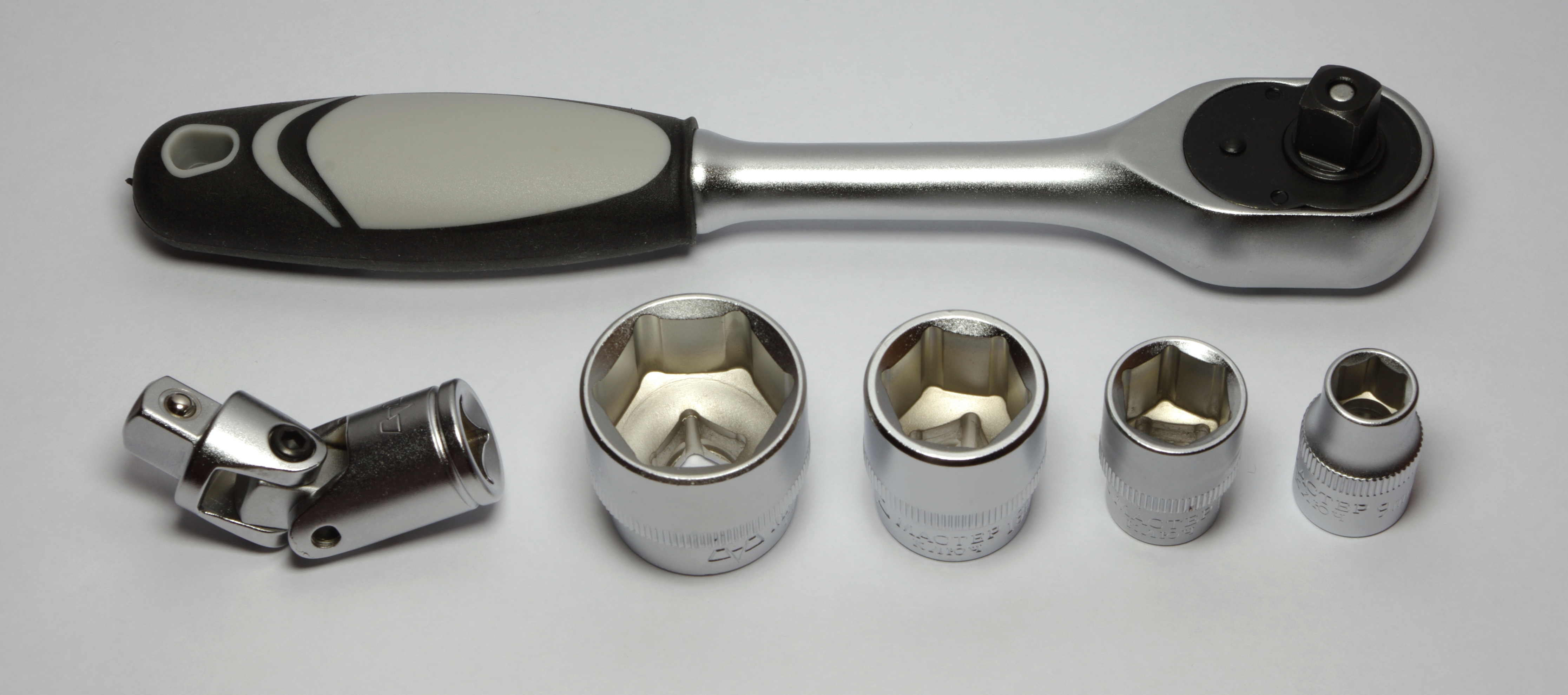
Rewind tools solve this by engaging the piston directly instead of pushing on its face. Most EPB pistons have two or three small drive notches machined into the face — the same notches the factory tool uses — and a rewind adapter is simply a plate or cube with matching pins that seat into those notches. Turn the adapter with a 3/8″ ratchet, a T-handle, or a low-torque powered driver, and the piston rotates down the spindle the way the motor would have driven it, just done by hand and under your control. Because pin spacing and bore diameter both vary by manufacturer, nearly every rewind kit ships as a set of several adapters rather than one universal tip.

The Best Disc Brake Caliper Tools Worth Buying
Lisle 25000 Rear Disc Brake Caliper Tool
Lisle’s 25000 is a mechanical rotate tool built specifically for rear calipers, using a driven cross-bar and a screw mechanism that turns the piston as it advances rather than just pushing it. The kit includes five adapters — sized at roughly 1-1/2″, 1-5/8″, 1-7/8″, 2-1/8″, and 2-1/2″ — to cover most domestic and import two- and four-wheel rear disc setups in one case (Lisle Corporation, retrieved 2026-08-11). It typically runs in the $75-$130 range depending on retailer, and each adapter is also sold separately if one wears out or a specific size goes missing.
Best for: shops and serious DIYers who want a dedicated, purpose-built rotating tool rather than a ratchet-and-adapter approach.
OEMTOOLS 24693 2 and 3 Pin Brake Rewind Adapter Set
OEMTOOLS’ 24693 set is a compact, adjustable 2-pin and 3-pin adapter pair sold through mainstream parts retailers including AutoZone, aimed squarely at the EPB rewind job (AutoZone, retrieved 2026-08-11). Because the pin spacing on both adapters is adjustable rather than fixed, one physical tool covers a range of drive-notch spacings across makes instead of needing a separate plate per vehicle, and it typically sells for $20-$35. It’s a hand tool only — you drive it with your own ratchet.
Best for: DIYers who need a compact, inexpensive rewind adapter for occasional rear pad jobs on one or two vehicles.
MADDOX / Harbor Freight 11-Piece Disc Brake Pad and Caliper Service Tool Kit
Harbor Freight’s item #63264 bundles 11 pieces — a T-handle driver, a retaining plate, and a range of disc adapters — built from carbon steel and priced at $41.99 against an OEM comparison price the retailer lists near $79 (Harbor Freight, retrieved 2026-08-11). Harbor Freight lists compatibility across a long roster of makes including Audi, Chrysler, Ford, GM, Honda, Jaguar, Mazda, Mini Cooper, Mitsubishi, Nissan, Saturn, Subaru, Toyota, Volkswagen, and Volvo. It’s the least expensive way into a rotating-style kit with real adapter variety, though the finish and adapter tolerances are noticeably less refined than the shop-grade sets above and below it.
Best for: budget-conscious DIYers who need broad make coverage for occasional use and don’t mind a step down in fit and finish.
Orion Motor Tech 26-Piece Pneumatic Brake Caliper Wind Back Tool Set
Orion Motor Tech’s pneumatic kit swaps the ratchet for an air-powered driver, bundling an air compressor tool with 22 disc drive-key adapters and two caliper hangers to keep calipers out of the way during the job (Orion Motor Tech, retrieved 2026-08-11). The adapters are machined from 45# steel, and because the driver is air-powered, rotating a piston takes seconds instead of dozens of ratchet clicks. It’s priced above the hand-tool sets in this list, generally in the $110-$160 range depending on bundle, and it requires a shop air line or a portable compressor to use at all.
Best for: shops doing enough rear EPB jobs weekly that hand-cranking a ratchet adapter becomes a real time cost.
Astro Pneumatic 78618 18-Piece Brake Caliper Wind Back Tool Set
Astro Pneumatic’s 78618 is an 18-piece hand-driven set sold through professional tool suppliers and auto body outlets, built around a broader adapter range than the entry-level kits without stepping up to a pneumatic driver (Astro Pneumatic Tools, retrieved 2026-08-11). It sits in the middle of this lineup on both price and adapter count, and it’s commonly stocked alongside Astro’s other brake-service tools at the same retailers.
Best for: shops that want more adapter coverage than a Harbor Freight-tier kit without the cost or air-line requirement of a pneumatic set.
Lisle 25200 Adjustable Brake Caliper Tool, 2 & 3 Pin
Lisle’s 25200 is the company’s take on the adjustable pin adapter, similar in concept to the OEMTOOLS 24693 but built to Lisle’s tolerances and sold as a standalone 2-pin/3-pin tool rather than a bundled kit (Lisle Corporation, retrieved 2026-08-11). If you already own a compression kit for standard calipers and just need rewind capability added, this is a focused, lower-cost way to do it.
Best for: buyers who already own a push-style compression kit and just need to add EPB rewind capability.
Rewind Tools at a Glance: Pins, Drive Type, and Fit
| Tool | Drive type | Pin/adapter count | Approx. price |
|---|---|---|---|
| OEMTOOLS 24693 | Hand ratchet, adjustable pins | 2-pin + 3-pin | $20-$35 |
| Lisle 25200 | Hand ratchet, adjustable pins | 2-pin + 3-pin | $25-$40 |
| Lisle 25000 | Mechanical cross-bar/screw | 5 fixed adapters | $75-$130 |
| Harbor Freight 11-pc (MADDOX) | Hand T-handle | 11 pieces | $41.99 |
| Astro Pneumatic 78618 | Hand ratchet | 18 pieces | $85-$120 |
| Orion Motor Tech pneumatic set | Air-powered driver | 22 adapters | $110-$160 |
Using a Rewind Adapter Correctly
Before touching the piston, confirm whether your vehicle needs a service or maintenance mode. Some EPB systems allow manual retraction with the ignition off and the motor de-energized; others require a scan tool to release the motor’s hold on the piston first, and cranking a rewind adapter against an energized motor is one of the fastest ways to damage the actuator regardless of tool quality (iFixit, retrieved 2026-08-11). Once the caliper is ready, seat the adapter’s pins fully into the drive notches before applying torque — a partially seated pin can slip out under load and round off the notch, making the piston harder to engage on future services.
Most EPB pistons retract with clockwise rotation, but this is not universal, and turning the adapter the wrong direction under load can bind the spindle rather than retract it. Check the direction specified for your make before you start, and stop immediately if the piston tightens up rather than moving smoothly — that resistance almost always means the wrong rotation direction or a pin that’s slipped partially out of its notch. Keep an eye on the brake fluid reservoir while you work, too: a rotated piston displaces fluid back toward the reservoir the same way a pushed one does, and a reservoir already near the “Max” mark can overflow if you don’t check it first.
Work the piston down in short, controlled increments rather than one long continuous crank, pausing to confirm the pins stay seated and the piston retracts evenly rather than cocking to one side. Once it clears new pads, inspect the dust boot for tearing before reinstalling — a boot pinched during the rewind needs to be reseated or replaced, since a torn boot lets contaminants into the bore and shortens the caliper’s life.
Front Push Tools vs. Rear Rewind Tools: Two Different Jobs
It’s worth being explicit about the distinction this guide is built around, since the two tool categories get confused constantly at the parts counter. A front caliper on most vehicles is still a standard sliding design: the piston floats in its bore under hydraulic pressure alone, and a C-clamp or screw-and-cube compression tool pushes it straight back with no rotation involved. That’s a simpler mechanism, and our brake caliper compression tool guide covers the push-style kits built for exactly that job. A rear EPB caliper is a different mechanism entirely — a threaded spindle driven by a motor, requiring rotation instead of a push — and that’s what every tool in this guide handles. Buying the wrong category isn’t a minor inefficiency; on an EPB piston, it’s the difference between a routine pad swap and a caliper you now have to replace.
If you’re not sure which your rear axle has, check the dashboard for an electric parking brake switch (often a “P” inside a circle) instead of a mechanical lever or pedal, and look at the caliper itself once the wheel is off — an EPB caliper has a visible motor housing with a wiring connector bolted to its back that a standard sliding caliper simply doesn’t have. If you’re also shopping for pads for this job, our ceramic brake pads guide covers friction material choices, and if you need to bleed the system afterward, see our brake bleeder kit guide.
Frequently Asked Questions
Can I use a regular compression tool on an EPB caliper if I go slowly?
No. The issue isn’t speed, it’s motion type. A push-style tool has no way to rotate the piston, and forcing it straight back against a threaded spindle risks stripping the mechanism regardless of how carefully you apply pressure.
How do I know which pin adapter fits my vehicle?
Most rewind kits list vehicle compatibility by pin count (2-pin or 3-pin) and adjustable spacing range. Check your specific caliper’s drive-notch pattern against the kit’s listed coverage, or look up your vehicle’s year, make, and model alongside “EPB rewind tool” before buying.
Do I need an air compressor for a pneumatic rewind kit?
Yes. Pneumatic sets like Orion Motor Tech’s require a shop air line or a portable compressor to drive the tool; without one, a hand-driven set like the OEMTOOLS or Lisle adapters is the better fit.
Is a mechanical tool like the Lisle 25000 better than a simple pin adapter?
Not universally better, just different in approach. The Lisle 25000 uses a built-in screw mechanism to drive the rotation for you, while a pin adapter relies on your own ratchet. The adapter is cheaper and more compact; the dedicated tool can feel more controlled on stiffer pistons.
What happens if I turn the piston the wrong direction?
Most EPB pistons retract clockwise, but this varies by manufacturer. Turning the wrong direction under load can bind the spindle instead of retracting the piston, so confirm the correct rotation for your specific vehicle before applying torque.
The Bottom Line
If your rear axle has an electric parking brake, skip anything labeled as a straight compression tool and buy a rewind adapter built to rotate the piston — an OEMTOOLS 24693 or Lisle 25200 for occasional jobs, a Harbor Freight 11-piece kit if budget is the priority, or a dedicated Lisle 25000, Astro Pneumatic 78618, or Orion Motor Tech pneumatic set if you’re doing this often enough to want broader adapter coverage or a powered driver. Confirm your vehicle’s service-mode requirement and rotation direction before you start, and the piston will retract cleanly instead of turning a pad job into a caliper replacement.