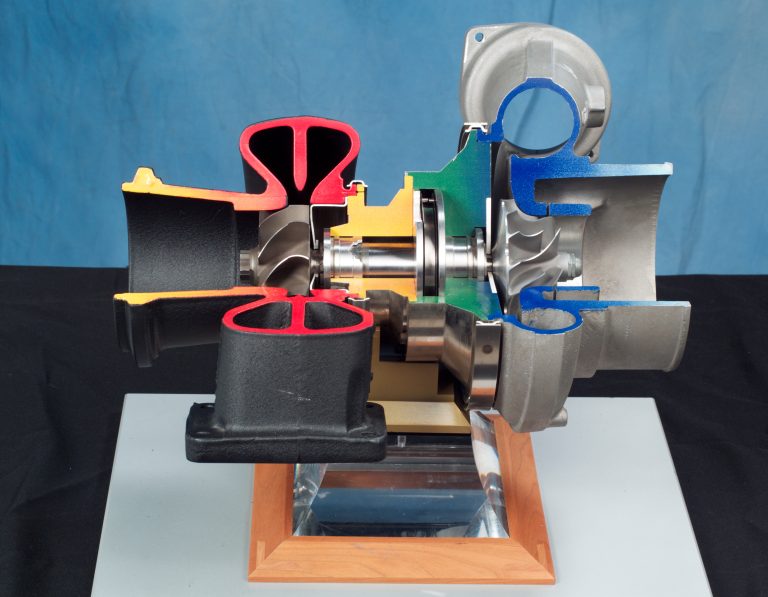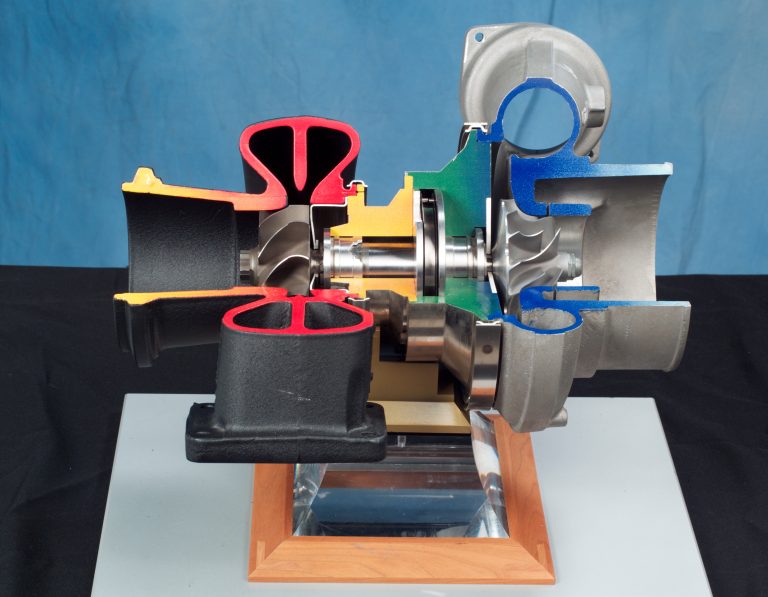
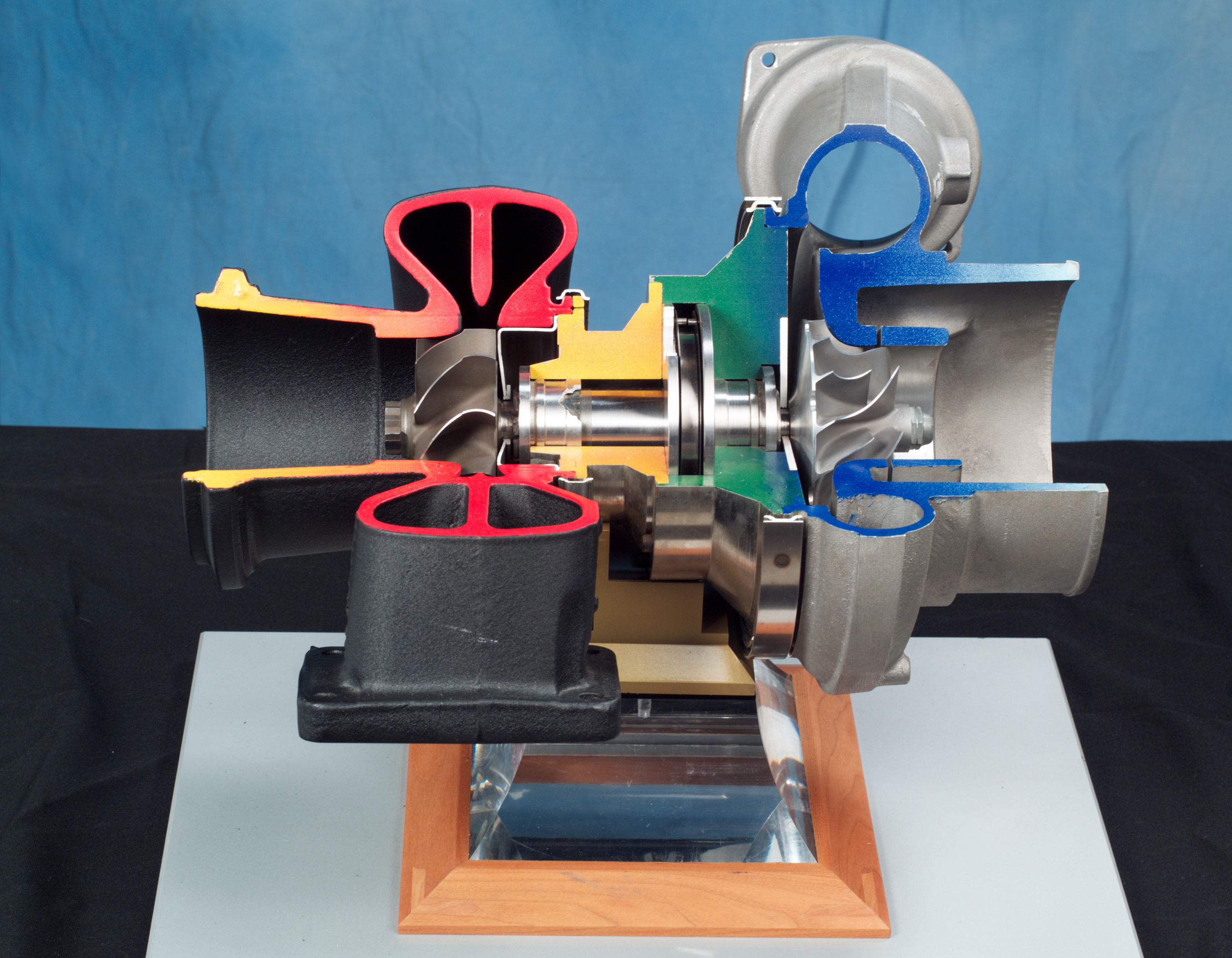
Turbocharger cutaway showing the compressor wheel, turbine wheel, and center-housing shaft. Photo: Quentin Schwinn, NASA Glenn Research Center (public domain).
Type “Precision Turbo” into a parts search and you’ll get a wall of model numbers — PT6062, PT6266, PT6875, PT7685 — with almost no explanation of what any of it means. Precision Turbo & Engine (PTE) doesn’t sell one turbo called “the Precision Turbo.” It sells four separate product lines spanning roughly 500 to 2,500+ horsepower, and the two digits before and after the hyphen in every model number tell you the compressor and turbine wheel sizes in millimeters — not the power rating, not the frame class, and not which one bolts to your manifold.
This guide breaks down what the PT numbering actually encodes, how the Sportsman, Street and Race Gen2, Next Gen, and Pro Mod lines differ, when a ball-bearing center housing is worth the premium over a journal-bearing unit, and how to size a Precision Turbo to a power goal instead of buying on frame size alone. It also links out to platform-specific builds already covered on this site, since the turbo is only ever half of what decides whether a swap works.
Key Takeaways
- Precision Turbo model numbers encode compressor inducer size and turbine wheel size in millimeters (e.g., PT6266 = 62mm compressor / 66mm turbine) — not a horsepower figure.
- The Gen2 Street and Race lineup spans roughly 750 hp (PT6062) to 1,300 hp (PT7675) using the same CEA compressor-wheel technology, so the frame you need depends entirely on your power target.
- Ball-bearing CHRAs spool a few hundred RPM sooner and tolerate more heat cycling than journal-bearing units, but the difference is smallest on street-driven, moderately boosted builds and largest on drag and road-race applications with rapid throttle transitions.
- A turbo is one line item in a build. Manifold flange type, intercooler sizing, and fueling capacity decide whether a Precision Turbo actually makes the power its compressor map suggests.
- Buy through an authorized Precision Turbo dealer network listing — the aftermarket has enough grey-market and relabeled units in circulation that serial-number verification matters as much as the spec sheet.
What Does a Precision Turbo Model Number Actually Mean?
A Precision Turbo model number is a compressor-and-turbine size code, not a power rating. In “PT6266,” the 62 is the compressor wheel’s inducer diameter in millimeters and the 66 is the turbine wheel’s diameter. A PT6062 (60mm compressor / 62mm turbine) is a physically smaller, quicker-spooling unit than a PT6266, which is smaller again than a PT7675 (76mm compressor / 75mm turbine). Horsepower capability follows the trim and A/R (area-to-radius) housing chosen around that core, so two people can buy the “same” PT6266 and land 100+ hp apart depending on turbine housing size and boost target.
Precision’s current cores use what the company brands CEA (Competition Engineered Aerodynamics) compressor wheels, machined from 2618-aluminum forgings rather than cast, which is the same compressor-design language you’ll see across the Sportsman, Street and Race Gen2, and Next Gen lines (Precision Turbo & Engine, retrieved 2026-08-08). The wheel technology is shared; what changes between product lines is housing options, bearing configuration, and the frame sizes offered.
If you’re still deciding whether a big-frame turbo is even the right call for your engine, our GT45 turbo frame-sizing breakdown covers the same “bigger number isn’t automatically better” math that applies here.
How Do the Sportsman, Street and Race Gen2, and Next Gen Lines Differ?
Precision Turbo currently sells four tiers, and they scale roughly with intended power and duty cycle rather than being simple “good/better/best” upgrades of each other.
- Sportsman — the entry frame sizes built around ball-bearing CHRAs at accessible price points, aimed at street and street/strip builds in the 500-900 hp range.
- Street and Race Gen2 — the core CEA-compressor lineup most shops recommend for serious street cars and weekend racers, spanning roughly 750-1,300 hp depending on frame (Edge Autosport product data, retrieved 2026-08-08).
- Next Gen — an updated compressor and cover design over the Sportsman platform; Precision cites the Next Gen Sportsman 6875 CEA at roughly 1,200 hp and the 7485 CEA at “upwards of 1,400 hp” (IP-Precision Turbo dealer listings, retrieved 2026-08-08).
- Pro Mod — the drag-racing-only tier built for engines already making four-digit horsepower, rated well past 2,000 hp (SpeedFactory Racing, retrieved 2026-08-08).
The chart below plots the Gen2 Street and Race lineup by manufacturer/dealer-published horsepower rating so you can see how tightly the frame sizes are spaced.
Note the gap between PT6466 (900 hp) and PT7675 (1,300 hp) — there’s no Gen2 Street and Race model in between, which is exactly the range where a lot of builders end up choosing between a maxed-out PT6466 and an undersized PT7675. If your power goal sits in that 900-1,100 hp band, cross-shop the Next Gen 6875 and Sportsman equivalents before committing.
Is a Ball-Bearing Precision Turbo Worth the Extra Cost?
A ball-bearing CHRA earns its premium on builds that need fast recovery between shifts or throttle blips — drag cars, road-race cars, and anything driven aggressively in stop-and-go traffic — less so on a mild street build where boost comes on gradually and stays steady. Precision’s Sportsman and Gen2 lines ship standard with an air-cooled, dual ceramic ball-bearing center housing, and the mechanism is straightforward: ball bearings roll rather than slide against the shaft, which cuts rotating friction compared to a journal (sleeve) bearing riding on a hydrodynamic oil film.
What that buys you in practice is a shaft that gets moving sooner off idle and, more noticeably, recovers boost faster between gear changes than an otherwise-identical journal-bearing unit. It does not fundamentally change the turbo’s peak flow or its efficiency map — a ball-bearing PT6266 and a journal-bearing PT6266 move the same air at the same boost pressure once both are fully spooled. The advantage is entirely in transient response, and it shows up most on applications with the least time to build boost: quarter-mile passes and road-course corner exits, not a cruise-in car that spends most of its time at steady highway boost.
If quicker spool independent of bearing type is the actual goal, our ball bearing turbo guide walks through where the real spool gains come from — wheel design, A/R sizing, and bearing type each play a role, and they’re not interchangeable levers.
How Do You Size a Precision Turbo to Your Power Goal?
Size the compressor to the horsepower you actually plan to make at your target boost, not the biggest frame your budget allows. Precision publishes compressor maps for every core, and the practical shortcut most tuners use is matching your projected mass airflow requirement to the compressor’s efficient operating island — buy too small and you run out of flow at high RPM (and cook the compressor trying to make up for it); buy too big and you’re fighting turbo lag and poor low-end response for headroom you’ll never use.
The qualitative comparison below summarizes the tradeoffs across bearing type and frame size that shape a sizing decision — it’s a planning framework based on general turbocharger engineering principles, not a numeric benchmark from a single test.
Two practical rules follow from that chart. First, if your build sees a lot of throttle transitions — autocross, road course, stop-and-go street driving with regular boost hits — the ball-bearing spool advantage compounds every time you get back into boost, which is where the real seat-of-the-pants difference shows up. Second, if your build is a dedicated drag car making one pull at a time from a rolling or standing start, journal bearing’s lower cost is harder to argue against, since the turbo has the whole burnout and staging process to spool before it matters.
For platform-specific sizing math — where compression ratio, not just power goal, sets your safe boost ceiling — see our guides for the K24, 2JZ-GE, and IS300 platforms, all of which walk through how stock compression narrows or widens your turbo options before you even get to frame size.
Which Platforms Are Precision Turbo Swaps Actually Common On?
Precision Turbo cores show up across an unusually wide range of platforms because the company sells bare turbos and lets kit manufacturers and tuners build the plumbing around them, rather than selling only complete bolt-on kits for specific cars. That’s different from a brand like Garrett’s GT-series, which you’ll also see specified in many of the same kits, but it means “does a Precision Turbo fit my car” is really a question about whether a manifold and downpipe exist for your engine, not about the turbo itself.
On this site, the platform-specific turbo kit guides that most commonly spec a Precision Turbo core as the upgrade path (alongside Garrett and Borg Warner options) include:
- KA24DE turbo kit — where the stock connecting rods, not the turbo, set the ceiling
- Honda S2000 turbo kit — where the F20C’s compression ratio decides frame size before anything else does
- Miata turbo kit — three different shopping lists depending on NA/NB, NC, or ND generation
- B20 turbo kit — where sleeve quality gates how big a Precision Turbo you can safely run
- N54 turbo kit — where the stock fuel system, not the turbo, is usually the real ceiling
- BRZ turbo kit — capped hard by the FA20’s 12.5:1 compression ratio
- SBC turbo kit — where block type and oil drain sizing decide your boost ceiling
- 5.3 Vortec turbo kit — where iron LM7 versus aluminum LM4 blocks aren’t equally suited to boost
- Silverado turbo kit — relevant if you’re working around a factory-turbocharged 2.7L instead of the 5.3L V8
- Jeep 4.0 turbo kit — where most universal kits skip the injector and MAP sensor upgrade the swap actually needs
If your engine isn’t on that list, our universal turbo kit guide covers what “universal” actually guarantees (the flange, not the fitment) when you’re building a Precision Turbo setup from scratch rather than buying a kit engineered for your specific car.
What Else Does a Precision Turbo Build Actually Need?
A Precision Turbo is one component in a system, and undersizing any of the other three — exhaust manifold, intercooler, and fuel delivery — will cap the power the turbo itself is capable of. Manifold design affects turbine-side spool and backpressure; log-style manifolds are cheaper and easier to package, while equal-length headers reduce pulse interference at the cost of packaging complexity, a tradeoff covered in depth in our LS turbo headers comparison.
On the intake side, a bigger turbo moving more air needs a charge cooler sized to match it, or the compressor’s efficiency gains get erased by the heat it generates. Most street and strip builds land on a front-mount intercooler sized to the power target rather than the biggest core that fits, while builds prioritizing charge-temperature consistency over multiple pulls sometimes move to an air-to-water intercooler instead, accepting its heat-soak tradeoff for a colder first hit of boost.
A rough planning allocation for where the budget typically goes on a full turbo build — turbo core, manifold and hardware, intercooler and piping, fueling, and tuning — looks like the breakdown below. Treat it as a starting planning reference, not a fixed rule; individual builds vary widely based on what’s already on the car.
How Do You Avoid Buying a Counterfeit or Mismatched Precision Turbo?
Buy from an authorized Precision Turbo & Engine dealer and cross-check the part number and serial tag against the dealer’s listing before you install it. The aftermarket turbo market has enough relabeled, gray-market, and outright counterfeit units in circulation — the same problem covered in our GT45 turbo guide’s genuine-versus-clone section — that a listing price well under every other dealer’s is a signal to slow down, not a deal to jump on. A genuine unit ships with Precision’s compressor map documentation and a traceable serial number; a listing that can’t produce either on request is a red flag regardless of how convincing the photos look.
Frequently Asked Questions
Is a Precision Turbo better than a Garrett turbo?
Neither brand is categorically better; both make competitive CEA-style forged compressor wheels at comparable frame sizes, and the practical choice usually comes down to which brand your chosen manifold, kit, or tuner already has a proven map for. Cross-reference against options in our platform-specific guides above before assuming one brand is the default.
Can I run a Precision Turbo without an aftermarket ECU?
On most modern platforms, no — adding a turbo changes airflow, fueling, and timing requirements enough that a stock, naturally-aspirated ECU calibration can’t safely manage it. Nearly every platform-specific kit guide linked above treats a standalone or piggyback ECU as a required part of the build, not an optional upgrade.
How much does a Precision Turbo cost?
Bare Gen2 Street and Race cores from authorized dealers typically list from around $1,000 for smaller frames like the PT6062 up past $2,500+ for the largest Next Gen and Pro Mod units, before manifold, piping, fueling, and tuning costs. Treat the turbo’s sticker price as roughly a third of the total build budget, per the allocation chart above.
Bottom Line
Buy a Precision Turbo by matching the model number’s compressor and turbine sizing to your actual horsepower goal and boost target, not by chasing the biggest frame that fits your budget. The Gen2 Street and Race lineup covers roughly 750-1,300 hp in four steps, ball-bearing CHRAs earn their premium on builds with frequent throttle transitions rather than steady-state cruising, and the turbo itself is only ever one part of a system that also needs a matched manifold, intercooler, and fuel system to actually deliver the power the compressor map promises. Start from your platform’s specific compression and fueling limits — covered in the platform guides linked throughout this article — before you lock in a frame size.